Personal Development
PERSONAL DEVELOPMENT: A COMPLETE GUIDE TO UNLOCKING YOUR POTENTIAL AND LIVING WITH PURPOSE
Discover a complete personal development guide covering goal setting, habit building, mindset shifts, time management, and Islamic principles for continuous self-improvement. Backed by research and faith.
TalkCPT Admin
Jun 01, 2026
20 min read
38 views
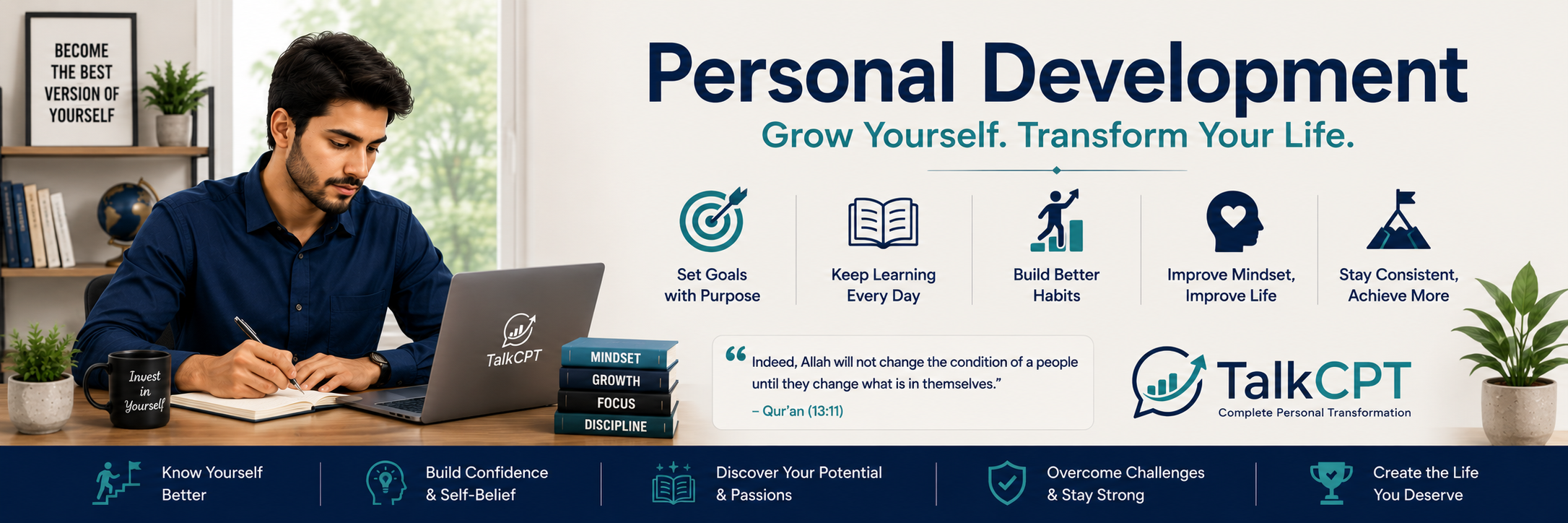
PERSONAL DEVELOPMENT: A COMPLETE GUIDE TO UNLOCKING YOUR POTENTIAL AND LIVING WITH PURPOSE
Personal development is the lifelong process of improving your skills, character, mindset, and habits to become the best version of yourself. It is not about becoming perfect. It is about growing intentionally, learning from experiences, and aligning your daily life with your deepest values and goals. This comprehensive guide combines modern personal development science with the profound wisdom of Islam, offering you a complete roadmap to unlock your potential and live a purposeful life.
WHAT IS PERSONAL DEVELOPMENT
Personal development, also called self-improvement or personal growth, is the conscious pursuit of growth in all areas of life. It includes building emotional intelligence, strengthening character, learning new skills, improving relationships, advancing your career, and nurturing your spiritual life. It is a holistic journey that touches the mind, body, and soul.
According to research in positive psychology, people who actively engage in personal development experience higher life satisfaction, better resilience, and greater professional success. Personal development is not a one-time event. It is a daily commitment to becoming a little better than you were yesterday.
Key areas of personal development include:
1. Mental growth – expanding knowledge and thinking skills
2. Emotional growth – understanding and managing emotions
3. Physical growth – caring for the body through health and fitness
4. Social growth – building communication and relationship skills
5. Spiritual growth – connecting with purpose, values, and faith
6. Professional growth – advancing skills and career capabilities
WHY PERSONAL DEVELOPMENT MATTERS
Without intentional growth, life becomes stagnant. Problems repeat. Frustrations build. Personal development gives you the tools to break cycles, overcome challenges, and create a life you find meaningful.
Research shows that individuals who invest in their personal growth:
1. Have greater clarity about their goals and direction
2. Handle stress and setbacks more effectively
3. Build stronger, healthier relationships
4. Perform better in their careers and studies
5. Experience deeper inner peace and contentment
6. Contribute more positively to their communities
In Islam, personal development is deeply encouraged. The Quran says: "Indeed, Allah will not change the condition of a people until they change what is in themselves" (Surah Ar-Ra'd, 13:11). This verse establishes a clear principle: change begins from within. A believer is expected to strive continuously to better their character, knowledge, and actions. The Prophet Muhammad (peace be upon him) said: "The best of people are those who bring most benefit to the rest of mankind" (Daraqutni). To benefit others, you must first develop yourself.
SETTING CLEAR GOALS FOR PERSONAL GROWTH
Goal setting is the engine of personal development. Without clear goals, effort becomes scattered and motivation fades. Research by Dr. Edwin Locke and Dr. Gary Latham shows that specific, challenging goals lead to significantly higher performance than vague intentions.
The SMART goal framework:
1. Specific – define exactly what you want to achieve
2. Measurable – include criteria to track progress
3. Achievable – ensure the goal is realistic with effort
4. Relevant – align the goal with your larger life purpose
5. Time-bound – set a deadline for completion
Additional tips for effective goal setting:
1. Write your goals down and review them daily or weekly
2. Break large goals into smaller, manageable steps
3. Visualise yourself achieving the goal regularly
4. Share your goals with a trusted person for accountability
5. Adjust goals as you learn and grow
In Islam, intention (niyyah) is the foundation of every action. The Prophet (peace be upon him) said: "Actions are but by intentions, and every person will have only what they intended" (Sahih al-Bukhari). Setting goals with a sincere intention to improve for the sake of Allah and to serve others adds spiritual barakah to your efforts.
BUILDING POWERFUL HABITS
Habits are the building blocks of personal development. Your daily routines shape your identity and determine your long-term results. James Clear, author of Atomic Habits, explains that small, consistent improvements compound into remarkable change over time.
The habit loop consists of:
1. Cue – the trigger that initiates the behaviour
2. Craving – the motivation or desire behind the habit
3. Response – the actual behaviour you perform
4. Reward – the benefit you gain from the behaviour
Strategies for building positive habits:
1. Start extremely small – a habit that takes two minutes is easy to begin
2. Attach new habits to existing ones (habit stacking)
3. Design your environment to make good habits easy and bad habits difficult
4. Track your habits daily to maintain consistency
5. Focus on identity – ask "Who do I want to become?" rather than "What do I want to achieve?"
6. Be patient – research suggests it takes an average of 66 days for a new habit to become automatic
Islamic teachings emphasise consistent, small actions. The Prophet (peace be upon him) said: "The most beloved of deeds to Allah are those that are most consistent, even if they are few" (Sahih al-Bukhari). This perfectly aligns with modern habit science. Tiny, daily acts of worship and self-improvement are more valuable than occasional grand efforts.
DEVELOPING A GROWTH MINDSET
Psychologist Dr. Carol Dweck identified two types of mindsets that dramatically affect personal development. A fixed mindset believes that intelligence and talent are static, leading people to avoid challenges for fear of failure. A growth mindset believes that abilities can be developed through effort, learning, and persistence. People with a growth mindset embrace challenges, learn from criticism, and find inspiration in the success of others.
How to cultivate a growth mindset:
1. Replace "I cannot do this" with "I cannot do this yet"
2. View failures as learning opportunities, not as personal flaws
3. Seek challenges that stretch your abilities
4. Value the process of effort, not just the outcome
5. Accept constructive feedback and use it to improve
6. Celebrate progress, not just perfection
The Islamic concept of ihsan (excellence) supports a growth mindset. Allah loves that a believer strives to do their best in all things. The Quran states: "And those who strive for Us – We will surely guide them to Our ways. And indeed, Allah is with the doers of good" (Surah Al-Ankabut, 29:69). Striving itself is rewarded, regardless of the immediate outcome.
MASTERING TIME MANAGEMENT
Time is the most precious resource for personal development. It cannot be saved, only invested. Effective time management allows you to focus on what truly matters instead of being busy but unproductive.
Key time management principles:
1. Identify your most important tasks using the Eisenhower Matrix (urgent vs. important)
2. Plan each day the night before or first thing in the morning
3. Time-block your schedule, assigning specific hours to specific activities
4. Practice the Pomodoro Technique – 25 minutes of focused work followed by a 5-minute break
5. Eliminate or delegate low-value tasks that drain your time
6. Learn to say no to commitments that do not align with your priorities
7. Minimise distractions, especially from phones and social media
Islam places immense value on time. The Quran swears by time itself: "By time, indeed, mankind is in loss, except for those who have believed and done righteous deeds and advised each other to truth and advised each other to patience" (Surah Al-Asr, 103:1-3). This surah reminds believers that time is slipping away, and only meaningful actions preserve its value.
The Prophet (peace be upon him) advised: "Take advantage of five before five: your youth before your old age, your health before your sickness, your wealth before your poverty, your free time before your preoccupation, and your life before your death" (Al-Mustadrak al-Hakim). This hadith is a powerful call to intentional living.
CONTINUOUS LEARNING AND KNOWLEDGE
Personal development cannot happen without a commitment to learning. Knowledge expands your perspective, sharpens your skills, and opens doors to new opportunities. Lifelong learning keeps the mind agile and adaptable.
Ways to embrace continuous learning:
1. Read books regularly – aim for at least one book per month
2. Listen to educational podcasts or audiobooks during commutes
3. Take online courses to acquire new skills
4. Attend workshops, seminars, and conferences
5. Learn from mentors who have achieved what you aspire to
6. Reflect on your experiences through journaling
7. Stay curious and ask questions
In Islam, seeking knowledge is a sacred duty. The very first revelation was "Read in the name of your Lord who created" (Surah Al-Alaq, 96:1). The Prophet (peace be upon him) said: "Seeking knowledge is an obligation upon every Muslim" (Sunan Ibn Majah). This obligation is not limited to religious knowledge. Any beneficial knowledge that helps you serve others, earn a halal living, and understand the world is praiseworthy.
BUILDING SELF-DISCIPLINE
Self-discipline is the bridge between goals and accomplishment. It is the ability to do what needs to be done, even when you do not feel like doing it. Without self-discipline, the best intentions remain unrealised.
How to strengthen self-discipline:
1. Start with small acts of self-control daily
2. Remove temptations from your environment rather than relying on willpower alone
3. Create routines that reduce the need for constant decision-making
4. Use commitment devices, such as public declarations or accountability partners
5. Practice delayed gratification by resisting small immediate rewards for larger future ones
6. Forgive yourself after lapses and refocus immediately
7. Remember your deeper purpose when motivation fades
Islamic practices naturally build self-discipline. Fasting during Ramadan trains believers to control desires from dawn to sunset. The five daily prayers require stopping worldly activities at fixed times. The prohibition of alcohol, gossip, and other vices strengthens moral discipline. The Prophet (peace be upon him) said: "The strong man is not the one who can overpower others, but the one who can control himself when angry" (Sahih al-Bukhari). Self-control is a sign of true strength.
EMOTIONAL INTELLIGENCE AND CHARACTER DEVELOPMENT
Personal development includes refining your character and emotional skills. Emotional intelligence, popularised by Daniel Goleman, involves self-awareness, self-regulation, empathy, and social skills. High emotional intelligence leads to better relationships, career success, and inner stability.
Areas to develop:
1. Self-awareness – recognise your emotions and their triggers
2. Self-regulation – manage impulses and reactions
3. Empathy – understand and feel the emotions of others
4. Social skills – communicate effectively and resolve conflicts
5. Humility – accept feedback and admit mistakes
6. Patience – endure difficulties without losing composure
Islam is deeply concerned with character development. The Prophet (peace be upon him) was sent to perfect good character. He said: "I have been sent to perfect noble character" (Muwatta Malik). The Quran praises those who control anger and forgive others: "And those who restrain anger and who pardon the people – and Allah loves the doers of good" (Surah Aal-e-Imran, 3:134). Every act of patience and forgiveness is a step in personal development.
SPIRITUAL DEVELOPMENT AS THE CORE OF PERSONAL GROWTH
For a believer, spiritual development is the heart of personal development. Without a strong connection to Allah, all other growth can become hollow or misguided. Spiritual growth provides purpose, peace, and a moral compass.
Core spiritual development practices:
1. Performing the five daily prayers with presence and reflection
2. Reciting and pondering the Quran regularly
3. Engaging in dhikr (remembrance of Allah) throughout the day
4. Making sincere du'a for guidance and improvement
5. Seeking forgiveness (istighfar) for shortcomings
6. Reflecting on one's deeds daily (muhasabah)
7. Giving charity and serving others
8. Fasting voluntarily to purify the soul
9. Surrounding oneself with righteous company
10. Seeking beneficial knowledge of the religion
The Quran describes the process of spiritual purification as the path to success: "He has succeeded who purifies it, and he has failed who instills it [with corruption]" (Surah Ash-Shams, 91:9-10). Personal development in Islam ultimately aims at tazkiyah (purification of the soul).
THE CONCEPT OF MUHASABAH (SELF-ACCOUNTING)
A powerful Islamic personal development tool is muhasabah, which means taking daily account of your actions. Umar ibn al-Khattab (may Allah be pleased with him) famously said: "Hold yourself accountable before you are held accountable."
Practicing muhasabah:
1. Set aside a few minutes each night to review your day
2. Ask yourself: What did I do well today? Where did I fall short?
3. Repent sincerely for any mistakes or sins
4. Make a specific intention to improve the next day
5. Track your progress on personal goals and spiritual obligations
6. Express gratitude for the good you were able to do
This practice aligns with modern journaling and self-reflection techniques that psychologists recommend for personal growth. It builds self-awareness, accountability, and continuous improvement.
A 30-DAY PERSONAL DEVELOPMENT CHALLENGE
Small daily actions create massive long-term results. Here is a 30-day challenge to ignite your personal development journey.
Day 1: Write down your top five personal values.
Day 2: Identify one area of your life you most want to improve.
Day 3: Set one SMART goal for that area.
Day 4: Break that goal into three small action steps.
Day 5: Wake up 30 minutes earlier and use the time for yourself.
Day 6: Read ten pages of a personal development book.
Day 7: Write in a journal for ten minutes about your thoughts.
Day 8: Identify one bad habit you want to reduce.
Day 9: Replace that bad habit with a positive one today.
Day 10: Practice deep listening in every conversation.
Day 11: Do one thing outside your comfort zone.
Day 12: Write a gratitude list of ten things.
Day 13: Spend time in nature without your phone.
Day 14: Review your goal progress and adjust if needed.
Day 15: Learn something new through a short online course or video.
Day 16: Forgive someone who has hurt you, even internally.
Day 17: Practice saying no to an unnecessary request.
Day 18: Create a morning routine and follow it.
Day 19: Perform all prayers on time with full concentration.
Day 20: Write a letter to your future self.
Day 21: Identify a mentor or role model and study their habits.
Day 22: Fast voluntarily and reflect on self-discipline.
Day 23: Declutter your workspace and digital files.
Day 24: Give sincere compliments to three people.
Day 25: Make a du'a list of things you want to improve in yourself.
Day 26: Do a random act of kindness anonymously.
Day 27: Review your spending and align it with your values.
Day 28: Visualise your ideal self five years from now.
Day 29: Write down lessons learned from a past failure.
Day 30: Celebrate your growth and set intentions for the next 30 days.
Following even half of these steps will create noticeable momentum.
FREQUENTLY ASKED QUESTIONS ABOUT PERSONAL DEVELOPMENT
Q: How long does personal development take?
A: Personal development is a lifelong journey. Some habits can be built in a few months. Shifts in mindset can happen in moments but deepen over years. The goal is continuous progress, not a finish line.
Q: Can personal development conflict with Islamic teachings?
A: Personal development that aligns with Islamic values of humility, honesty, patience, and service to others is completely compatible. Issues arise when personal development promotes arrogance, selfish ambition, or violates moral boundaries. A believer filters all growth through the lens of faith.
Q: What if I keep failing to stick to my goals?
A: Failure is part of the process. Analyse why you slipped without harsh self-criticism. Adjust the goal or the approach. Seek support. And remember the Quranic promise: "Indeed, with hardship [will be] ease" (Surah Ash-Sharh, 94:6).
Q: How can I balance personal development with contentment?
A: Islam teaches both striving (for improvement) and contentment (with Allah's decree). Strive to improve daily, but also be deeply grateful for what you have now. The Prophet (peace be upon him) said: "Look at those who are below you, and do not look at those who are above you, for that is more likely to keep you from belittling the blessing of Allah" (Sahih Muslim). This balance prevents burnout and envy.
CONCLUSION: YOUR JOURNEY TOWARD YOUR BEST SELF
Personal development is one of the most rewarding journeys you can undertake. It turns ordinary lives into meaningful stories. By combining the best of modern psychology with the eternal wisdom of Islam, you gain both practical tools and a higher purpose.
Start today with one small step. Read a page. Write a goal. Make a du'a. Hold yourself accountable. Over time, these small efforts, blessed with sincerity, will transform your character, your life, and your relationship with Allah. May your journey of personal growth be continuous, blessed, and full of purpose.
RESEARCH REFERENCES
1. Locke, E. A., & Latham, G. P. – Goal setting theory (American Psychologist)
2. Dweck, C. – Mindset: The New Psychology of Success
3. Clear, J. – Atomic Habits
4. Goleman, D. – Emotional Intelligence
5. American Psychological Association – Personal growth and well-being (apa.org)
6. Quran.com – Surah Ar-Ra'd 13:11, Surah Al-Ankabut 29:69, Surah Al-Asr 103:1-3, Surah Al-Alaq 96:1, Surah Ash-Shams 91:9-10, Surah Ash-Sharh 94:6, Surah Aal-e-Imran 3:134
7. Sunnah.com – Sahih al-Bukhari, Sahih Muslim, Sunan Ibn Majah, Muwatta Malik, Al-Mustadrak al-Hakim
8. Daraqutni – Hadith on the best of people being most beneficial
Personal development is the lifelong process of improving your skills, character, mindset, and habits to become the best version of yourself. It is not about becoming perfect. It is about growing intentionally, learning from experiences, and aligning your daily life with your deepest values and goals. This comprehensive guide combines modern personal development science with the profound wisdom of Islam, offering you a complete roadmap to unlock your potential and live a purposeful life.
WHAT IS PERSONAL DEVELOPMENT
Personal development, also called self-improvement or personal growth, is the conscious pursuit of growth in all areas of life. It includes building emotional intelligence, strengthening character, learning new skills, improving relationships, advancing your career, and nurturing your spiritual life. It is a holistic journey that touches the mind, body, and soul.
According to research in positive psychology, people who actively engage in personal development experience higher life satisfaction, better resilience, and greater professional success. Personal development is not a one-time event. It is a daily commitment to becoming a little better than you were yesterday.
Key areas of personal development include:
1. Mental growth – expanding knowledge and thinking skills
2. Emotional growth – understanding and managing emotions
3. Physical growth – caring for the body through health and fitness
4. Social growth – building communication and relationship skills
5. Spiritual growth – connecting with purpose, values, and faith
6. Professional growth – advancing skills and career capabilities
WHY PERSONAL DEVELOPMENT MATTERS
Without intentional growth, life becomes stagnant. Problems repeat. Frustrations build. Personal development gives you the tools to break cycles, overcome challenges, and create a life you find meaningful.
Research shows that individuals who invest in their personal growth:
1. Have greater clarity about their goals and direction
2. Handle stress and setbacks more effectively
3. Build stronger, healthier relationships
4. Perform better in their careers and studies
5. Experience deeper inner peace and contentment
6. Contribute more positively to their communities
In Islam, personal development is deeply encouraged. The Quran says: "Indeed, Allah will not change the condition of a people until they change what is in themselves" (Surah Ar-Ra'd, 13:11). This verse establishes a clear principle: change begins from within. A believer is expected to strive continuously to better their character, knowledge, and actions. The Prophet Muhammad (peace be upon him) said: "The best of people are those who bring most benefit to the rest of mankind" (Daraqutni). To benefit others, you must first develop yourself.
SETTING CLEAR GOALS FOR PERSONAL GROWTH
Goal setting is the engine of personal development. Without clear goals, effort becomes scattered and motivation fades. Research by Dr. Edwin Locke and Dr. Gary Latham shows that specific, challenging goals lead to significantly higher performance than vague intentions.
The SMART goal framework:
1. Specific – define exactly what you want to achieve
2. Measurable – include criteria to track progress
3. Achievable – ensure the goal is realistic with effort
4. Relevant – align the goal with your larger life purpose
5. Time-bound – set a deadline for completion
Additional tips for effective goal setting:
1. Write your goals down and review them daily or weekly
2. Break large goals into smaller, manageable steps
3. Visualise yourself achieving the goal regularly
4. Share your goals with a trusted person for accountability
5. Adjust goals as you learn and grow
In Islam, intention (niyyah) is the foundation of every action. The Prophet (peace be upon him) said: "Actions are but by intentions, and every person will have only what they intended" (Sahih al-Bukhari). Setting goals with a sincere intention to improve for the sake of Allah and to serve others adds spiritual barakah to your efforts.
BUILDING POWERFUL HABITS
Habits are the building blocks of personal development. Your daily routines shape your identity and determine your long-term results. James Clear, author of Atomic Habits, explains that small, consistent improvements compound into remarkable change over time.
The habit loop consists of:
1. Cue – the trigger that initiates the behaviour
2. Craving – the motivation or desire behind the habit
3. Response – the actual behaviour you perform
4. Reward – the benefit you gain from the behaviour
Strategies for building positive habits:
1. Start extremely small – a habit that takes two minutes is easy to begin
2. Attach new habits to existing ones (habit stacking)
3. Design your environment to make good habits easy and bad habits difficult
4. Track your habits daily to maintain consistency
5. Focus on identity – ask "Who do I want to become?" rather than "What do I want to achieve?"
6. Be patient – research suggests it takes an average of 66 days for a new habit to become automatic
Islamic teachings emphasise consistent, small actions. The Prophet (peace be upon him) said: "The most beloved of deeds to Allah are those that are most consistent, even if they are few" (Sahih al-Bukhari). This perfectly aligns with modern habit science. Tiny, daily acts of worship and self-improvement are more valuable than occasional grand efforts.
DEVELOPING A GROWTH MINDSET
Psychologist Dr. Carol Dweck identified two types of mindsets that dramatically affect personal development. A fixed mindset believes that intelligence and talent are static, leading people to avoid challenges for fear of failure. A growth mindset believes that abilities can be developed through effort, learning, and persistence. People with a growth mindset embrace challenges, learn from criticism, and find inspiration in the success of others.
How to cultivate a growth mindset:
1. Replace "I cannot do this" with "I cannot do this yet"
2. View failures as learning opportunities, not as personal flaws
3. Seek challenges that stretch your abilities
4. Value the process of effort, not just the outcome
5. Accept constructive feedback and use it to improve
6. Celebrate progress, not just perfection
The Islamic concept of ihsan (excellence) supports a growth mindset. Allah loves that a believer strives to do their best in all things. The Quran states: "And those who strive for Us – We will surely guide them to Our ways. And indeed, Allah is with the doers of good" (Surah Al-Ankabut, 29:69). Striving itself is rewarded, regardless of the immediate outcome.
MASTERING TIME MANAGEMENT
Time is the most precious resource for personal development. It cannot be saved, only invested. Effective time management allows you to focus on what truly matters instead of being busy but unproductive.
Key time management principles:
1. Identify your most important tasks using the Eisenhower Matrix (urgent vs. important)
2. Plan each day the night before or first thing in the morning
3. Time-block your schedule, assigning specific hours to specific activities
4. Practice the Pomodoro Technique – 25 minutes of focused work followed by a 5-minute break
5. Eliminate or delegate low-value tasks that drain your time
6. Learn to say no to commitments that do not align with your priorities
7. Minimise distractions, especially from phones and social media
Islam places immense value on time. The Quran swears by time itself: "By time, indeed, mankind is in loss, except for those who have believed and done righteous deeds and advised each other to truth and advised each other to patience" (Surah Al-Asr, 103:1-3). This surah reminds believers that time is slipping away, and only meaningful actions preserve its value.
The Prophet (peace be upon him) advised: "Take advantage of five before five: your youth before your old age, your health before your sickness, your wealth before your poverty, your free time before your preoccupation, and your life before your death" (Al-Mustadrak al-Hakim). This hadith is a powerful call to intentional living.
CONTINUOUS LEARNING AND KNOWLEDGE
Personal development cannot happen without a commitment to learning. Knowledge expands your perspective, sharpens your skills, and opens doors to new opportunities. Lifelong learning keeps the mind agile and adaptable.
Ways to embrace continuous learning:
1. Read books regularly – aim for at least one book per month
2. Listen to educational podcasts or audiobooks during commutes
3. Take online courses to acquire new skills
4. Attend workshops, seminars, and conferences
5. Learn from mentors who have achieved what you aspire to
6. Reflect on your experiences through journaling
7. Stay curious and ask questions
In Islam, seeking knowledge is a sacred duty. The very first revelation was "Read in the name of your Lord who created" (Surah Al-Alaq, 96:1). The Prophet (peace be upon him) said: "Seeking knowledge is an obligation upon every Muslim" (Sunan Ibn Majah). This obligation is not limited to religious knowledge. Any beneficial knowledge that helps you serve others, earn a halal living, and understand the world is praiseworthy.
BUILDING SELF-DISCIPLINE
Self-discipline is the bridge between goals and accomplishment. It is the ability to do what needs to be done, even when you do not feel like doing it. Without self-discipline, the best intentions remain unrealised.
How to strengthen self-discipline:
1. Start with small acts of self-control daily
2. Remove temptations from your environment rather than relying on willpower alone
3. Create routines that reduce the need for constant decision-making
4. Use commitment devices, such as public declarations or accountability partners
5. Practice delayed gratification by resisting small immediate rewards for larger future ones
6. Forgive yourself after lapses and refocus immediately
7. Remember your deeper purpose when motivation fades
Islamic practices naturally build self-discipline. Fasting during Ramadan trains believers to control desires from dawn to sunset. The five daily prayers require stopping worldly activities at fixed times. The prohibition of alcohol, gossip, and other vices strengthens moral discipline. The Prophet (peace be upon him) said: "The strong man is not the one who can overpower others, but the one who can control himself when angry" (Sahih al-Bukhari). Self-control is a sign of true strength.
EMOTIONAL INTELLIGENCE AND CHARACTER DEVELOPMENT
Personal development includes refining your character and emotional skills. Emotional intelligence, popularised by Daniel Goleman, involves self-awareness, self-regulation, empathy, and social skills. High emotional intelligence leads to better relationships, career success, and inner stability.
Areas to develop:
1. Self-awareness – recognise your emotions and their triggers
2. Self-regulation – manage impulses and reactions
3. Empathy – understand and feel the emotions of others
4. Social skills – communicate effectively and resolve conflicts
5. Humility – accept feedback and admit mistakes
6. Patience – endure difficulties without losing composure
Islam is deeply concerned with character development. The Prophet (peace be upon him) was sent to perfect good character. He said: "I have been sent to perfect noble character" (Muwatta Malik). The Quran praises those who control anger and forgive others: "And those who restrain anger and who pardon the people – and Allah loves the doers of good" (Surah Aal-e-Imran, 3:134). Every act of patience and forgiveness is a step in personal development.
SPIRITUAL DEVELOPMENT AS THE CORE OF PERSONAL GROWTH
For a believer, spiritual development is the heart of personal development. Without a strong connection to Allah, all other growth can become hollow or misguided. Spiritual growth provides purpose, peace, and a moral compass.
Core spiritual development practices:
1. Performing the five daily prayers with presence and reflection
2. Reciting and pondering the Quran regularly
3. Engaging in dhikr (remembrance of Allah) throughout the day
4. Making sincere du'a for guidance and improvement
5. Seeking forgiveness (istighfar) for shortcomings
6. Reflecting on one's deeds daily (muhasabah)
7. Giving charity and serving others
8. Fasting voluntarily to purify the soul
9. Surrounding oneself with righteous company
10. Seeking beneficial knowledge of the religion
The Quran describes the process of spiritual purification as the path to success: "He has succeeded who purifies it, and he has failed who instills it [with corruption]" (Surah Ash-Shams, 91:9-10). Personal development in Islam ultimately aims at tazkiyah (purification of the soul).
THE CONCEPT OF MUHASABAH (SELF-ACCOUNTING)
A powerful Islamic personal development tool is muhasabah, which means taking daily account of your actions. Umar ibn al-Khattab (may Allah be pleased with him) famously said: "Hold yourself accountable before you are held accountable."
Practicing muhasabah:
1. Set aside a few minutes each night to review your day
2. Ask yourself: What did I do well today? Where did I fall short?
3. Repent sincerely for any mistakes or sins
4. Make a specific intention to improve the next day
5. Track your progress on personal goals and spiritual obligations
6. Express gratitude for the good you were able to do
This practice aligns with modern journaling and self-reflection techniques that psychologists recommend for personal growth. It builds self-awareness, accountability, and continuous improvement.
A 30-DAY PERSONAL DEVELOPMENT CHALLENGE
Small daily actions create massive long-term results. Here is a 30-day challenge to ignite your personal development journey.
Day 1: Write down your top five personal values.
Day 2: Identify one area of your life you most want to improve.
Day 3: Set one SMART goal for that area.
Day 4: Break that goal into three small action steps.
Day 5: Wake up 30 minutes earlier and use the time for yourself.
Day 6: Read ten pages of a personal development book.
Day 7: Write in a journal for ten minutes about your thoughts.
Day 8: Identify one bad habit you want to reduce.
Day 9: Replace that bad habit with a positive one today.
Day 10: Practice deep listening in every conversation.
Day 11: Do one thing outside your comfort zone.
Day 12: Write a gratitude list of ten things.
Day 13: Spend time in nature without your phone.
Day 14: Review your goal progress and adjust if needed.
Day 15: Learn something new through a short online course or video.
Day 16: Forgive someone who has hurt you, even internally.
Day 17: Practice saying no to an unnecessary request.
Day 18: Create a morning routine and follow it.
Day 19: Perform all prayers on time with full concentration.
Day 20: Write a letter to your future self.
Day 21: Identify a mentor or role model and study their habits.
Day 22: Fast voluntarily and reflect on self-discipline.
Day 23: Declutter your workspace and digital files.
Day 24: Give sincere compliments to three people.
Day 25: Make a du'a list of things you want to improve in yourself.
Day 26: Do a random act of kindness anonymously.
Day 27: Review your spending and align it with your values.
Day 28: Visualise your ideal self five years from now.
Day 29: Write down lessons learned from a past failure.
Day 30: Celebrate your growth and set intentions for the next 30 days.
Following even half of these steps will create noticeable momentum.
FREQUENTLY ASKED QUESTIONS ABOUT PERSONAL DEVELOPMENT
Q: How long does personal development take?
A: Personal development is a lifelong journey. Some habits can be built in a few months. Shifts in mindset can happen in moments but deepen over years. The goal is continuous progress, not a finish line.
Q: Can personal development conflict with Islamic teachings?
A: Personal development that aligns with Islamic values of humility, honesty, patience, and service to others is completely compatible. Issues arise when personal development promotes arrogance, selfish ambition, or violates moral boundaries. A believer filters all growth through the lens of faith.
Q: What if I keep failing to stick to my goals?
A: Failure is part of the process. Analyse why you slipped without harsh self-criticism. Adjust the goal or the approach. Seek support. And remember the Quranic promise: "Indeed, with hardship [will be] ease" (Surah Ash-Sharh, 94:6).
Q: How can I balance personal development with contentment?
A: Islam teaches both striving (for improvement) and contentment (with Allah's decree). Strive to improve daily, but also be deeply grateful for what you have now. The Prophet (peace be upon him) said: "Look at those who are below you, and do not look at those who are above you, for that is more likely to keep you from belittling the blessing of Allah" (Sahih Muslim). This balance prevents burnout and envy.
CONCLUSION: YOUR JOURNEY TOWARD YOUR BEST SELF
Personal development is one of the most rewarding journeys you can undertake. It turns ordinary lives into meaningful stories. By combining the best of modern psychology with the eternal wisdom of Islam, you gain both practical tools and a higher purpose.
Start today with one small step. Read a page. Write a goal. Make a du'a. Hold yourself accountable. Over time, these small efforts, blessed with sincerity, will transform your character, your life, and your relationship with Allah. May your journey of personal growth be continuous, blessed, and full of purpose.
RESEARCH REFERENCES
1. Locke, E. A., & Latham, G. P. – Goal setting theory (American Psychologist)
2. Dweck, C. – Mindset: The New Psychology of Success
3. Clear, J. – Atomic Habits
4. Goleman, D. – Emotional Intelligence
5. American Psychological Association – Personal growth and well-being (apa.org)
6. Quran.com – Surah Ar-Ra'd 13:11, Surah Al-Ankabut 29:69, Surah Al-Asr 103:1-3, Surah Al-Alaq 96:1, Surah Ash-Shams 91:9-10, Surah Ash-Sharh 94:6, Surah Aal-e-Imran 3:134
7. Sunnah.com – Sahih al-Bukhari, Sahih Muslim, Sunan Ibn Majah, Muwatta Malik, Al-Mustadrak al-Hakim
8. Daraqutni – Hadith on the best of people being most beneficial
Remember
It’s okay to feel stressed sometimes. But taking small, consistent steps can help you feel more in control and live a happier, healthier life.
Share this article
Talk to Our Personal Development Experts
 Online
Dr. Ayesha Khalid
Clinical Psychologist
MS Clinical Psychology
4.9
(230)
Lahore
PKR 5,000
/ session
 Available
Muhammad Bilal
Career Coach
MBA Human Resource Management
4.9
(210)
Karachi
PKR 4,000
/ session
 Online
Sarah Khan
AI & Prompt Engineer
BS Software Engineering
4.8
(180)
Islamabad
PKR 3,500
/ session
Smoke Expert
Prompt Coach
Certified AI trainer
0.0
(0)
Lahore
PKR 2,500
/ session