Career Growth
CAREER GROWTH: A COMPLETE GUIDE TO ACHIEVING PROFESSIONAL SUCCESS AND FULFILLMENT
Discover a complete career growth guide with practical strategies for goal setting, skill development, networking, leadership, and Islamic principles for ethical success. Backed by research and timeless wisdom.
TalkCPT Admin
May 31, 2026
20 min read
40 views
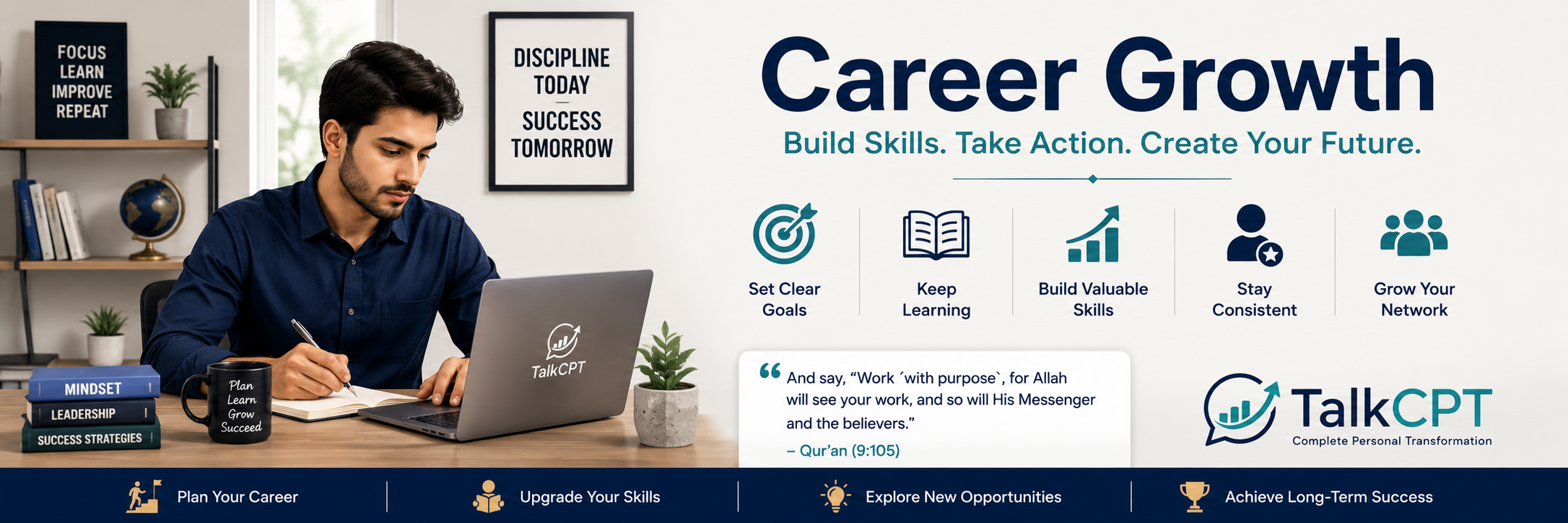
CAREER GROWTH: A COMPLETE GUIDE TO ACHIEVING PROFESSIONAL SUCCESS AND FULFILLMENT
Career growth is not just about earning a bigger salary or achieving a higher job title. It is about continuous learning, developing valuable skills, and finding meaning and integrity in your professional life. In a fast-changing world, those who actively plan and nurture their career growth are the ones who build lasting success and personal satisfaction. This complete guide combines modern research, proven career strategies, and Islamic principles of work and excellence to help you thrive professionally while staying true to your values.
WHAT IS CAREER GROWTH
Career growth means the ongoing process of advancing in your professional life. It includes earning promotions, gaining new skills, expanding responsibilities, and sometimes changing industries to follow a deeper calling. True career growth aligns your work with your strengths, passions, and long-term goals.
It is not only about climbing a corporate ladder. Career growth also means:
1. Developing deep expertise in your field
2. Increasing your ability to solve complex problems
3. Building a strong professional reputation
4. Expanding your network of trusted colleagues
5. Achieving financial stability through honest work
6. Finding personal satisfaction and a sense of contribution
WHY CAREER GROWTH MATTERS FOR OVERALL WELL-BEING
Research shows that meaningful work and professional progress are closely linked to emotional and mental health. The American Psychological Association highlights that job satisfaction reduces stress, improves self-esteem, and enhances overall life happiness. Stagnation, on the other hand, can lead to frustration, anxiety, and a loss of motivation.
Career growth matters because it:
1. Provides a sense of purpose and direction
2. Builds confidence through visible achievements
3. Opens doors to better opportunities and financial security
4. Keeps your mind sharp through continuous learning
5. Allows you to serve others through your skills and knowledge
6. Strengthens your ability to adapt to economic changes
Islamic teachings also encourage believers to strive for excellence in their work. The Quran says: “And say, ‘Do [as you will], for Allah will see your deeds, and [so will] His Messenger and the believers…’” (Surah At-Tawbah, 9:105). This verse reminds us that our work is seen and valued, so it should be done with care and honesty. The Prophet Muhammad (peace be upon him) also said: “Indeed, Allah loves that when one of you does a job, he does it with perfection” (Al-Bayhaqi). This principle of Ihsan (excellence) applies to every profession.
SETTING CLEAR CAREER GOALS
Without clear goals, career growth becomes random and slow. Goal setting provides a roadmap for your professional journey. Psychologists Edwin Locke and Gary Latham found that specific, challenging goals lead to higher performance than vague intentions.
Effective career goal setting includes:
1. Defining your long-term vision (where you want to be in 5 or 10 years)
2. Breaking that vision into yearly and quarterly objectives
3. Making goals SMART – Specific, Measurable, Achievable, Relevant, and Time-bound
4. Writing your goals down and reviewing them weekly
5. Adjusting goals as you learn more about yourself and the market
6. Seeking guidance from mentors who have achieved similar goals
In Islam, intention (niyyah) is central to any action. The Prophet (peace be upon him) said: “Actions are but by intentions, and every person will have only what they intended” (Sahih al-Bukhari). Starting your career goals with a sincere intention to earn halal provision, serve others, and grow as a person brings barakah (blessing) to your efforts.
DEVELOPING HIGH-VALUE SKILLS
In the modern economy, skills are the real currency of career growth. Employers and clients pay for value, not for years of experience alone. Research by the World Economic Forum shows that skills like analytical thinking, creativity, emotional intelligence, and technology literacy are among the fastest-growing in demand.
To accelerate your career growth, focus on building:
1. Hard skills – technical knowledge specific to your field, such as coding, data analysis, accounting, or design
2. Soft skills – communication, teamwork, leadership, adaptability, and emotional intelligence
3. Self-management skills – time management, resilience, and self-discipline
4. Digital literacy – understanding of digital tools, social media, and basic technology platforms
5. Industry-specific credentials – certifications and degrees that prove your expertise
Islam encourages the pursuit of beneficial knowledge. The Prophet (peace be upon him) said: “Seeking knowledge is an obligation upon every Muslim” (Sunan Ibn Majah). This knowledge can be religious or worldly, as long as it brings benefit and does not lead to harm.
BUILDING A STRONG PROFESSIONAL NETWORK
Career growth rarely happens in isolation. The people you know and who know your work can open doors that your CV alone cannot. Research by LinkedIn and other career platforms consistently shows that a significant percentage of job opportunities are filled through networking rather than public advertisements.
Steps to build a meaningful professional network:
1. Attend industry events, seminars, and webinars regularly
2. Connect with colleagues and leaders on professional platforms like LinkedIn
3. Offer help and share knowledge without expecting immediate returns
4. Seek informational interviews with people in roles you admire
5. Maintain relationships by checking in genuinely, not only when you need something
6. Join professional associations and groups in your field
7. Be known for reliability, honesty, and a good attitude
In Islam, maintaining good relationships and community ties is heavily emphasised. The Prophet (peace be upon him) taught that a believer who mixes with people and bears their difficulties with patience is better than one who isolates himself (Sunan al-Tirmidhi). Networking with good character is a form of positive social engagement.
CRAFTING YOUR PERSONAL BRAND
Your personal brand is your professional reputation. It is what people say about your work when you are not in the room. A strong personal brand makes career growth smoother because opportunities come to you rather than you always chasing them.
Elements of a strong personal brand:
1. Consistent quality of work that meets or exceeds expectations
2. A clear area of expertise that you are known for
3. A professional online presence, especially on LinkedIn and industry platforms
4. Published articles, talks, or projects that showcase your knowledge
5. Testimonials and recommendations from managers, clients, or colleagues
6. Authenticity – being known as someone with integrity, not just skill
The Quran instructs believers not to mix truth with falsehood or conceal the truth knowingly (Surah Al-Baqarah, 2:42). In a professional context, this means your personal brand should be based on genuine competence and honesty, not exaggeration or dishonesty.
OVERCOMING OBSTACLES TO CAREER GROWTH
Every professional faces obstacles. These may include lack of opportunities, fear of failure, burnout, toxic work environments, or limited resources. How you respond to these obstacles defines your long-term growth.
Common obstacles and how to overcome them:
1. Fear of rejection – reframe rejection as redirection and a learning experience
2. Lack of skills – commit to lifelong learning through courses, books, and practice
3. Imposter syndrome – remind yourself of your achievements and the value you bring
4. Toxic workplace – set boundaries, seek support, and plan a strategic exit if necessary
5. Procrastination – break large goals into tiny, daily actions that feel manageable
6. Burnout – prioritise rest, family time, and spiritual reflection as part of your growth plan
Islam teaches that hardship is followed by ease. Allah says: “Indeed, with hardship [will be] ease” (Surah Ash-Sharh, 94:6). This verse provides spiritual strength to keep pushing forward, trusting that struggle is part of the path to growth.
SEEKING MENTORSHIP AND GUIDANCE
One of the fastest ways to accelerate career growth is to learn from those who have already walked the path. A mentor provides advice, feedback, and connections that can save you years of trial and error.
How to find and benefit from a mentor:
1. Identify professionals in your field whose careers you admire
2. Approach them respectfully, expressing specific reasons for seeking their guidance
3. Be prepared with clear questions and topics for discussion
4. Show appreciation for their time and follow through on their advice
5. Be a mentor to someone else when you are able, continuing the cycle of growth
Islamic tradition places great value on consultation (Shura). The Quran describes believers as those whose affairs are conducted through mutual consultation (Surah Ash-Shura, 42:38). Seeking advice from experienced, trustworthy people is a sign of wisdom, not weakness.
BALANCING AMBITION WITH CONTENTMENT
Career growth is important, but endless ambition without contentment can lead to burnout and a loss of spiritual peace. True success lies in striving for excellence while being grateful for what you have already achieved.
Ways to maintain balance:
1. Regularly reflect on your achievements, not just your next goal
2. Practice gratitude for your current job, colleagues, and skills
3. Dedicate time to family, health, and worship alongside your career
4. Define success in a holistic way that includes character and service, not just income
5. Trust that your provision (rizq) is ultimately in Allah’s hands, which reduces anxiety
The Prophet (peace be upon him) said: “Richness is not having many possessions, but richness is being content with oneself” (Sahih al-Bukhari). This hadith redefines success in a way that protects the heart while the hands continue to work.
A 30-DAY CAREER GROWTH CHALLENGE
Small daily actions create massive long-term results. Here is a 30-day challenge to kickstart your career growth.
Day 1: Write down your top 3 career goals for the next year.
Day 2: Identify 2 skills you need to develop to reach those goals.
Day 3: Research 3 online courses or books on those skills.
Day 4: Update your LinkedIn profile with a professional photo and summary.
Day 5: Reach out to one former colleague to reconnect.
Day 6: Read one article on industry trends in your field.
Day 7: Reflect on a recent work challenge and write what you learned.
Day 8: Ask a trusted colleague for honest feedback on your strengths.
Day 9: Identify one task you can delegate or eliminate to free up time.
Day 10: Practice a 5-minute deep work session on your most important task.
Day 11: Write a short post sharing something you learned recently.
Day 12: Attend a free webinar or listen to a career podcast.
Day 13: Make a list of 10 companies or roles you admire.
Day 14: Contact one person in your network for an informational chat.
Day 15: Organise your workspace and digital files for better focus.
Day 16: Set a specific, measurable target for the next quarter.
Day 17: Learn one new tool or software relevant to your field.
Day 18: Offer help to a colleague without expecting anything in return.
Day 19: Review your CV or portfolio and make one improvement.
Day 20: Practice answering a common interview question out loud.
Day 21: Read about a successful person in your industry and their journey.
Day 22: Meditate or make du’a for clarity and barakah in your work.
Day 23: Identify a bad work habit and replace it with a positive one.
Day 24: Join one professional group online and introduce yourself.
Day 25: Track how you spend your time for a full day and note distractions.
Day 26: Write a thank-you note to a mentor or teacher who helped you.
Day 27: Review your goals and adjust any that no longer inspire you.
Day 28: Create a simple personal website or portfolio if applicable.
Day 29: Prepare a 30-second introduction that describes who you are professionally.
Day 30: Celebrate your progress and set intentions for the next month.
Following even half of these steps with consistency will build momentum and clarity.
WHEN TO CONSIDER A CAREER CHANGE
Sometimes career growth means recognising that your current path is no longer right for you. Signs that a change may be needed include:
1. Persistent lack of motivation and dread about work
2. Values that clash with the company culture
3. No learning or growth opportunities for a long period
4. Physical or mental health suffering due to work stress
5. A strong, consistent pull towards a different field
A career change is not failure. It is a strategic decision based on self-awareness. Praying Istikhara (prayer for guidance) when making major career decisions is a beautiful Islamic practice that brings peace and clarity.
FREQUENTLY ASKED QUESTIONS ABOUT CAREER GROWTH
Q: How long does it take to see real career growth?
A: Career growth is a continuous process. Some improvements, like learning a new skill, can show results in a few months. Major shifts, like a promotion or career change, may take a year or more. Consistency and patience are key. Trust that small efforts compound over time.
Q: Is it wrong to want a high salary and status in Islam?
A: Islam does not forbid seeking wealth or status, as long as they are earned through halal means and do not lead to arrogance, injustice, or neglect of religious obligations. The danger lies in making wealth the ultimate goal rather than a tool for good. The Quran reminds us that the best provision is righteousness (Surah Al-Baqarah, 2:197).
Q: How can I grow my career while maintaining work-life balance?
A: Prioritise tasks ruthlessly, set clear boundaries around work hours, and schedule family and personal time just as you would a work meeting. Remember that a burned-out person cannot sustain long-term growth. Balance is part of Islamic moderation (wasatiyyah), which is a praised quality.
CONCLUSION: YOUR CAREER GROWTH JOURNEY IS A LIFELONG BLESSING
Career growth, when approached with sincerity, effort, and ethics, is not just a worldly pursuit. It is a means of serving others, providing for your family, and fulfilling a trust. Combine the best of modern career strategies with the spiritual depth of Islamic teachings, and you will build a professional life that is successful, meaningful, and blessed.
Start today with one small action. Update your CV. Learn a new skill. Say a sincere du’a for guidance. Every step counts, and every effort is seen. May your career be a source of growth, dignity, and lasting benefit.
RESEARCH REFERENCES
1. American Psychological Association – Work and well-being (apa.org)
2. Locke, E. A., & Latham, G. P. – Goal setting theory (summary in multiple journals)
3. World Economic Forum – Future of Jobs Report (weforum.org)
4. LinkedIn – The value of networking and personal branding (linkedin.com)
5. Quran.com – Surah At-Tawbah 9:105, Surah Ash-Sharh 94:6, Surah Ash-Shura 42:38, Surah Al-Baqarah 2:197
6. Sunnah.com – Sahih al-Bukhari, Sahih Muslim, Sunan Ibn Majah, Sunan al-Tirmidhi
7. Al-Bayhaqi – Hadith on excellence in work
Career growth is not just about earning a bigger salary or achieving a higher job title. It is about continuous learning, developing valuable skills, and finding meaning and integrity in your professional life. In a fast-changing world, those who actively plan and nurture their career growth are the ones who build lasting success and personal satisfaction. This complete guide combines modern research, proven career strategies, and Islamic principles of work and excellence to help you thrive professionally while staying true to your values.
WHAT IS CAREER GROWTH
Career growth means the ongoing process of advancing in your professional life. It includes earning promotions, gaining new skills, expanding responsibilities, and sometimes changing industries to follow a deeper calling. True career growth aligns your work with your strengths, passions, and long-term goals.
It is not only about climbing a corporate ladder. Career growth also means:
1. Developing deep expertise in your field
2. Increasing your ability to solve complex problems
3. Building a strong professional reputation
4. Expanding your network of trusted colleagues
5. Achieving financial stability through honest work
6. Finding personal satisfaction and a sense of contribution
WHY CAREER GROWTH MATTERS FOR OVERALL WELL-BEING
Research shows that meaningful work and professional progress are closely linked to emotional and mental health. The American Psychological Association highlights that job satisfaction reduces stress, improves self-esteem, and enhances overall life happiness. Stagnation, on the other hand, can lead to frustration, anxiety, and a loss of motivation.
Career growth matters because it:
1. Provides a sense of purpose and direction
2. Builds confidence through visible achievements
3. Opens doors to better opportunities and financial security
4. Keeps your mind sharp through continuous learning
5. Allows you to serve others through your skills and knowledge
6. Strengthens your ability to adapt to economic changes
Islamic teachings also encourage believers to strive for excellence in their work. The Quran says: “And say, ‘Do [as you will], for Allah will see your deeds, and [so will] His Messenger and the believers…’” (Surah At-Tawbah, 9:105). This verse reminds us that our work is seen and valued, so it should be done with care and honesty. The Prophet Muhammad (peace be upon him) also said: “Indeed, Allah loves that when one of you does a job, he does it with perfection” (Al-Bayhaqi). This principle of Ihsan (excellence) applies to every profession.
SETTING CLEAR CAREER GOALS
Without clear goals, career growth becomes random and slow. Goal setting provides a roadmap for your professional journey. Psychologists Edwin Locke and Gary Latham found that specific, challenging goals lead to higher performance than vague intentions.
Effective career goal setting includes:
1. Defining your long-term vision (where you want to be in 5 or 10 years)
2. Breaking that vision into yearly and quarterly objectives
3. Making goals SMART – Specific, Measurable, Achievable, Relevant, and Time-bound
4. Writing your goals down and reviewing them weekly
5. Adjusting goals as you learn more about yourself and the market
6. Seeking guidance from mentors who have achieved similar goals
In Islam, intention (niyyah) is central to any action. The Prophet (peace be upon him) said: “Actions are but by intentions, and every person will have only what they intended” (Sahih al-Bukhari). Starting your career goals with a sincere intention to earn halal provision, serve others, and grow as a person brings barakah (blessing) to your efforts.
DEVELOPING HIGH-VALUE SKILLS
In the modern economy, skills are the real currency of career growth. Employers and clients pay for value, not for years of experience alone. Research by the World Economic Forum shows that skills like analytical thinking, creativity, emotional intelligence, and technology literacy are among the fastest-growing in demand.
To accelerate your career growth, focus on building:
1. Hard skills – technical knowledge specific to your field, such as coding, data analysis, accounting, or design
2. Soft skills – communication, teamwork, leadership, adaptability, and emotional intelligence
3. Self-management skills – time management, resilience, and self-discipline
4. Digital literacy – understanding of digital tools, social media, and basic technology platforms
5. Industry-specific credentials – certifications and degrees that prove your expertise
Islam encourages the pursuit of beneficial knowledge. The Prophet (peace be upon him) said: “Seeking knowledge is an obligation upon every Muslim” (Sunan Ibn Majah). This knowledge can be religious or worldly, as long as it brings benefit and does not lead to harm.
BUILDING A STRONG PROFESSIONAL NETWORK
Career growth rarely happens in isolation. The people you know and who know your work can open doors that your CV alone cannot. Research by LinkedIn and other career platforms consistently shows that a significant percentage of job opportunities are filled through networking rather than public advertisements.
Steps to build a meaningful professional network:
1. Attend industry events, seminars, and webinars regularly
2. Connect with colleagues and leaders on professional platforms like LinkedIn
3. Offer help and share knowledge without expecting immediate returns
4. Seek informational interviews with people in roles you admire
5. Maintain relationships by checking in genuinely, not only when you need something
6. Join professional associations and groups in your field
7. Be known for reliability, honesty, and a good attitude
In Islam, maintaining good relationships and community ties is heavily emphasised. The Prophet (peace be upon him) taught that a believer who mixes with people and bears their difficulties with patience is better than one who isolates himself (Sunan al-Tirmidhi). Networking with good character is a form of positive social engagement.
CRAFTING YOUR PERSONAL BRAND
Your personal brand is your professional reputation. It is what people say about your work when you are not in the room. A strong personal brand makes career growth smoother because opportunities come to you rather than you always chasing them.
Elements of a strong personal brand:
1. Consistent quality of work that meets or exceeds expectations
2. A clear area of expertise that you are known for
3. A professional online presence, especially on LinkedIn and industry platforms
4. Published articles, talks, or projects that showcase your knowledge
5. Testimonials and recommendations from managers, clients, or colleagues
6. Authenticity – being known as someone with integrity, not just skill
The Quran instructs believers not to mix truth with falsehood or conceal the truth knowingly (Surah Al-Baqarah, 2:42). In a professional context, this means your personal brand should be based on genuine competence and honesty, not exaggeration or dishonesty.
OVERCOMING OBSTACLES TO CAREER GROWTH
Every professional faces obstacles. These may include lack of opportunities, fear of failure, burnout, toxic work environments, or limited resources. How you respond to these obstacles defines your long-term growth.
Common obstacles and how to overcome them:
1. Fear of rejection – reframe rejection as redirection and a learning experience
2. Lack of skills – commit to lifelong learning through courses, books, and practice
3. Imposter syndrome – remind yourself of your achievements and the value you bring
4. Toxic workplace – set boundaries, seek support, and plan a strategic exit if necessary
5. Procrastination – break large goals into tiny, daily actions that feel manageable
6. Burnout – prioritise rest, family time, and spiritual reflection as part of your growth plan
Islam teaches that hardship is followed by ease. Allah says: “Indeed, with hardship [will be] ease” (Surah Ash-Sharh, 94:6). This verse provides spiritual strength to keep pushing forward, trusting that struggle is part of the path to growth.
SEEKING MENTORSHIP AND GUIDANCE
One of the fastest ways to accelerate career growth is to learn from those who have already walked the path. A mentor provides advice, feedback, and connections that can save you years of trial and error.
How to find and benefit from a mentor:
1. Identify professionals in your field whose careers you admire
2. Approach them respectfully, expressing specific reasons for seeking their guidance
3. Be prepared with clear questions and topics for discussion
4. Show appreciation for their time and follow through on their advice
5. Be a mentor to someone else when you are able, continuing the cycle of growth
Islamic tradition places great value on consultation (Shura). The Quran describes believers as those whose affairs are conducted through mutual consultation (Surah Ash-Shura, 42:38). Seeking advice from experienced, trustworthy people is a sign of wisdom, not weakness.
BALANCING AMBITION WITH CONTENTMENT
Career growth is important, but endless ambition without contentment can lead to burnout and a loss of spiritual peace. True success lies in striving for excellence while being grateful for what you have already achieved.
Ways to maintain balance:
1. Regularly reflect on your achievements, not just your next goal
2. Practice gratitude for your current job, colleagues, and skills
3. Dedicate time to family, health, and worship alongside your career
4. Define success in a holistic way that includes character and service, not just income
5. Trust that your provision (rizq) is ultimately in Allah’s hands, which reduces anxiety
The Prophet (peace be upon him) said: “Richness is not having many possessions, but richness is being content with oneself” (Sahih al-Bukhari). This hadith redefines success in a way that protects the heart while the hands continue to work.
A 30-DAY CAREER GROWTH CHALLENGE
Small daily actions create massive long-term results. Here is a 30-day challenge to kickstart your career growth.
Day 1: Write down your top 3 career goals for the next year.
Day 2: Identify 2 skills you need to develop to reach those goals.
Day 3: Research 3 online courses or books on those skills.
Day 4: Update your LinkedIn profile with a professional photo and summary.
Day 5: Reach out to one former colleague to reconnect.
Day 6: Read one article on industry trends in your field.
Day 7: Reflect on a recent work challenge and write what you learned.
Day 8: Ask a trusted colleague for honest feedback on your strengths.
Day 9: Identify one task you can delegate or eliminate to free up time.
Day 10: Practice a 5-minute deep work session on your most important task.
Day 11: Write a short post sharing something you learned recently.
Day 12: Attend a free webinar or listen to a career podcast.
Day 13: Make a list of 10 companies or roles you admire.
Day 14: Contact one person in your network for an informational chat.
Day 15: Organise your workspace and digital files for better focus.
Day 16: Set a specific, measurable target for the next quarter.
Day 17: Learn one new tool or software relevant to your field.
Day 18: Offer help to a colleague without expecting anything in return.
Day 19: Review your CV or portfolio and make one improvement.
Day 20: Practice answering a common interview question out loud.
Day 21: Read about a successful person in your industry and their journey.
Day 22: Meditate or make du’a for clarity and barakah in your work.
Day 23: Identify a bad work habit and replace it with a positive one.
Day 24: Join one professional group online and introduce yourself.
Day 25: Track how you spend your time for a full day and note distractions.
Day 26: Write a thank-you note to a mentor or teacher who helped you.
Day 27: Review your goals and adjust any that no longer inspire you.
Day 28: Create a simple personal website or portfolio if applicable.
Day 29: Prepare a 30-second introduction that describes who you are professionally.
Day 30: Celebrate your progress and set intentions for the next month.
Following even half of these steps with consistency will build momentum and clarity.
WHEN TO CONSIDER A CAREER CHANGE
Sometimes career growth means recognising that your current path is no longer right for you. Signs that a change may be needed include:
1. Persistent lack of motivation and dread about work
2. Values that clash with the company culture
3. No learning or growth opportunities for a long period
4. Physical or mental health suffering due to work stress
5. A strong, consistent pull towards a different field
A career change is not failure. It is a strategic decision based on self-awareness. Praying Istikhara (prayer for guidance) when making major career decisions is a beautiful Islamic practice that brings peace and clarity.
FREQUENTLY ASKED QUESTIONS ABOUT CAREER GROWTH
Q: How long does it take to see real career growth?
A: Career growth is a continuous process. Some improvements, like learning a new skill, can show results in a few months. Major shifts, like a promotion or career change, may take a year or more. Consistency and patience are key. Trust that small efforts compound over time.
Q: Is it wrong to want a high salary and status in Islam?
A: Islam does not forbid seeking wealth or status, as long as they are earned through halal means and do not lead to arrogance, injustice, or neglect of religious obligations. The danger lies in making wealth the ultimate goal rather than a tool for good. The Quran reminds us that the best provision is righteousness (Surah Al-Baqarah, 2:197).
Q: How can I grow my career while maintaining work-life balance?
A: Prioritise tasks ruthlessly, set clear boundaries around work hours, and schedule family and personal time just as you would a work meeting. Remember that a burned-out person cannot sustain long-term growth. Balance is part of Islamic moderation (wasatiyyah), which is a praised quality.
CONCLUSION: YOUR CAREER GROWTH JOURNEY IS A LIFELONG BLESSING
Career growth, when approached with sincerity, effort, and ethics, is not just a worldly pursuit. It is a means of serving others, providing for your family, and fulfilling a trust. Combine the best of modern career strategies with the spiritual depth of Islamic teachings, and you will build a professional life that is successful, meaningful, and blessed.
Start today with one small action. Update your CV. Learn a new skill. Say a sincere du’a for guidance. Every step counts, and every effort is seen. May your career be a source of growth, dignity, and lasting benefit.
RESEARCH REFERENCES
1. American Psychological Association – Work and well-being (apa.org)
2. Locke, E. A., & Latham, G. P. – Goal setting theory (summary in multiple journals)
3. World Economic Forum – Future of Jobs Report (weforum.org)
4. LinkedIn – The value of networking and personal branding (linkedin.com)
5. Quran.com – Surah At-Tawbah 9:105, Surah Ash-Sharh 94:6, Surah Ash-Shura 42:38, Surah Al-Baqarah 2:197
6. Sunnah.com – Sahih al-Bukhari, Sahih Muslim, Sunan Ibn Majah, Sunan al-Tirmidhi
7. Al-Bayhaqi – Hadith on excellence in work
Remember
It’s okay to feel stressed sometimes. But taking small, consistent steps can help you feel more in control and live a happier, healthier life.
Share this article
Talk to Our Career Growth Experts
 Online
Dr. Ayesha Khalid
Clinical Psychologist
MS Clinical Psychology
4.9
(230)
Lahore
PKR 5,000
/ session
 Available
Muhammad Bilal
Career Coach
MBA Human Resource Management
4.9
(210)
Karachi
PKR 4,000
/ session
 Online
Sarah Khan
AI & Prompt Engineer
BS Software Engineering
4.8
(180)
Islamabad
PKR 3,500
/ session
Smoke Expert
Prompt Coach
Certified AI trainer
0.0
(0)
Lahore
PKR 2,500
/ session