Home›Blogs›Relationship Guidance›Healthy Relationship Guidance: Communication, Respect, Trust, and Islamic Principles for Stronger Bonds
Relationship Guidance
Healthy Relationship Guidance: Communication, Respect, Trust, and Islamic Principles for Stronger Bonds
Healthy relationships are built through communication, respect, trust, emotional safety, patience, and mercy. This relationship guidance blog explains practical worldwide research-based advice with Islamic references for stronger personal and family bonds.
TalkCPT AdminMay 31, 202615 min read40 views
HEALTHY RELATIONSHIP GUIDANCE: COMMUNICATION, RESPECT, TRUST, AND ISLAMIC PRINCIPLES FOR STRONGER BONDS
Healthy relationships are one of the most important parts of a peaceful and successful life. A strong relationship does not become strong only because two people love each other. It becomes strong because both people learn how to communicate, respect, forgive, listen, support, and protect each other’s dignity.
Relationship guidance is important for couples, families, friends, and professional connections. Every relationship needs emotional maturity. Without communication and respect, even a good relationship can slowly become weak. With patience, trust, and sincere effort, even a struggling relationship can improve.
In today’s world, many people face relationship problems because of stress, financial pressure, social media comparison, ego, lack of time, family pressure, and poor communication. A healthy relationship does not mean there will never be disagreement. It means both people know how to handle disagreement with respect.
WHAT IS A HEALTHY RELATIONSHIP?
A healthy relationship is a connection where both people feel respected, safe, heard, and valued. It is not based on control, fear, emotional pressure, or constant blame. It is based on mutual care, trust, honesty, and responsibility.
According to the American Psychological Association, communication is a key part of healthy relationships, and healthy couples make regular time to check in with each other. (Reference: APA)
A healthy relationship usually includes:
1. Respect
2. Trust
3. Clear communication
4. Emotional support
5. Patience
6. Forgiveness
7. Personal boundaries
8. Shared responsibility
9. Loyalty
10. Mercy and kindness
When these qualities are missing, relationship problems can increase. People may start feeling ignored, controlled, misunderstood, or emotionally tired.
COMMUNICATION IS THE FOUNDATION OF RELATIONSHIP GUIDANCE
Communication is not only about speaking. It is also about listening with patience. Many people listen only to reply, not to understand. This creates arguments, distance, and emotional pain.
Good communication means:
1. Speaking clearly
2. Listening fully
3. Avoiding insults
4. Asking instead of assuming
5. Explaining feelings without attacking
6. Choosing the right time to discuss serious issues
For example, instead of saying:
“You never care about me.”
A better way is:
“I feel hurt when I do not feel heard.”
This small change can reduce defensiveness and open the door for a calm conversation.
Research on couples has found that negative communication is closely connected with relationship satisfaction. In simple words, when communication becomes harsh, blaming, or emotionally unsafe, relationship quality can suffer. (Reference: PMC)
SMALL EMOTIONAL MOMENTS MATTER
Strong relationships are not built only through big gifts, expensive dinners, or special events. They are built through small daily moments.
The Gottman Institute explains the concept of “bids for connection.” A bid can be a question, smile, comment, request, or emotional signal asking for attention and connection. (Reference: The Gottman Institute)
Examples of emotional bids:
1. “How was your day?”
2. “Can you sit with me for a few minutes?”
3. “Look at this.”
4. “I am feeling tired today.”
5. “Can we talk?”
When someone responds with care, the relationship becomes stronger. When these small moments are ignored repeatedly, emotional distance grows.
This is why relationship guidance is not only about solving big problems. It is also about protecting small daily moments.
RESPECT IS MORE IMPORTANT THAN EGO
Many relationships suffer because both people want to prove they are right. But a relationship is not a competition. If one person wins an argument but the relationship loses peace, that is not real success.
Respect means you do not humiliate the other person, even when you disagree. You do not use private weaknesses against them. You do not insult their family, character, appearance, past mistakes, or emotions.
A respectful person can say:
“I disagree with you, but I still respect you.”
This is emotional maturity.
ISLAMIC RELATIONSHIP GUIDANCE: LOVE, MERCY, AND TRANQUILITY
Islam gives a very balanced and beautiful framework for relationships, especially marriage and family life. Islam does not present relationships as only romance. It presents them as responsibility, mercy, kindness, protection, and peace.
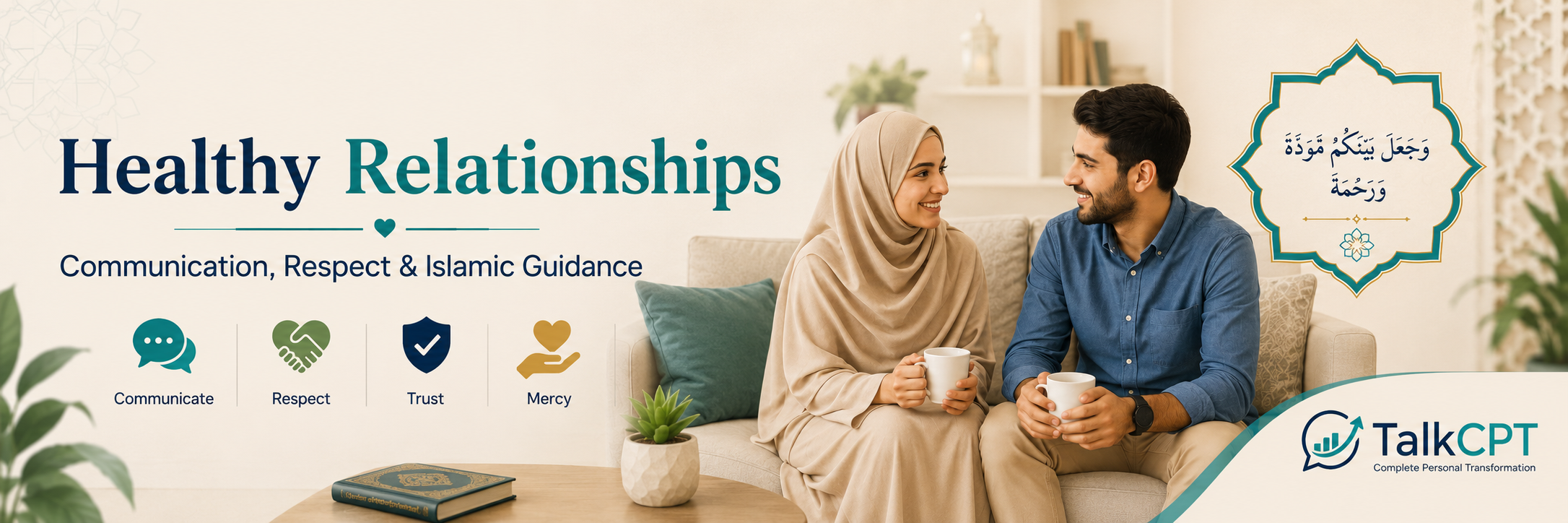
In the Qur’an, Allah says that He created spouses so that people may find comfort and tranquility in them, and He placed affection and mercy between them. (Reference: Quran.com, Surah Ar-Rum 30:21)
This verse gives a powerful foundation for Islamic relationship guidance:
1. Sukoon — emotional peace
2. Mawaddah — love and affection
3. Rahmah — mercy and compassion
A relationship without mercy becomes hard. A relationship without affection becomes cold. A relationship without peace becomes emotionally exhausting.
Islam teaches that a healthy relationship should not be based on fear, insult, or control. It should be based on kindness, justice, loyalty, and emotional responsibility.
KINDNESS IS A SIGN OF STRENGTH
Some people think being soft, forgiving, or patient means weakness. But in a healthy relationship, kindness is strength. It takes strength to control anger. It takes maturity to listen calmly. It takes faith to forgive sincerely.
Islamic teachings strongly encourage good character inside family life. The Prophet Muhammad ﷺ said: “The best of you are those who are best to their families, and I am the best to my family.” (Sunan al-Tirmidhi). Classical hadith collections such as Sahih al-Bukhari and Sahih Muslim are among the most recognized sources. (Reference: Sunnah)
In practical life, this means a person’s character should not only appear outside the home. Real character is shown in how someone treats the people closest to them.
BOUNDARIES MAKE RELATIONSHIPS HEALTHIER
Some people misunderstand boundaries. They think boundaries mean distance or disrespect. In reality, healthy boundaries protect relationships.
A boundary means:
“I respect you, but I also need respect.”
Examples of healthy boundaries:
1. Do not shout during arguments.
2. Do not check each other’s private phone without trust-based agreement.
3. Do not insult families.
4. Do not discuss private issues publicly.
5. Do not force someone to talk when emotions are too high.
6. Do not use silent treatment as punishment.
Boundaries help both people feel emotionally safe.
TRUST IS BUILT THROUGH CONSISTENCY
Trust is not built by promises only. It is built by repeated actions.
If someone says they care but repeatedly ignores, lies, hides important things, or breaks promises, trust becomes weak. If someone consistently shows honesty, responsibility, and respect, trust becomes stronger.
To build trust:
1. Speak truthfully
2. Keep promises
3. Avoid secretive behavior
4. Apologize sincerely
5. Do not repeat the same hurtful pattern
6. Be reliable in small matters
Trust grows slowly but can break quickly. That is why relationship guidance always includes honesty and consistency.
HOW TO HANDLE CONFLICT IN A HEALTHY WAY
Conflict is normal. Disrespect is not normal.
A healthy couple or family does not avoid every disagreement. They learn how to discuss disagreement without damaging the relationship.
During conflict:
1. Pause before reacting.
2. Lower your voice.
3. Focus on the issue, not the person.
4. Do not bring old issues into every new argument.
5. Avoid threats like “I will leave” unless it is a serious and necessary decision.
6. Take a break if emotions are too high.
7. Return to the conversation when both people are calmer.
A strong relationship is not one where people never argue. It is one where people repair after disagreement.
PRACTICAL RELATIONSHIP IMPROVEMENT PLAN (7-DAY PLAN)
Day 1: Listen Without Interrupting
Give the other person your full attention for 10 minutes.
Day 2: Appreciate One Good Quality
Say one honest appreciation.
Day 3: Avoid Blame Language
Use “I feel” instead of “you always.”
Day 4: Discuss One Boundary
Talk about one thing that can protect peace.
Day 5: Do One Small Act of Care
Send a kind message, make tea, help with work, or ask about their day.
Day 6: Apologize for One Mistake
A sincere apology can reduce emotional distance.
Day 7: Make One Shared Plan
Plan something simple together: a walk, meal, family visit, or personal goal.
Small actions repeated consistently can change the emotional direction of a relationship.
WHEN RELATIONSHIP GUIDANCE IS NEEDED
Relationship guidance may be needed when:
1. Communication becomes aggressive
2. Trust is repeatedly broken
3. One person feels emotionally unsafe
4. Arguments happen too often
5. There is constant disrespect
6. Family interference creates serious pressure
7. One or both people feel unheard
8. There is emotional distance
9. Forgiveness becomes difficult
In serious cases involving emotional abuse, violence, threats, or extreme control, professional help and safety support should be prioritized.
FREQUENTLY ASKED QUESTIONS (FAQ)
Q: What if my partner does not want to work on the relationship?
A: Focus on your own positive changes first. Often, one person’s shift in behaviour can influence the dynamic. Engage in gentle, non-blaming dialogue. If necessary, involve a neutral third party like a counsellor or a wise family elder.
Q: How can Islamic teachings help with jealousy or trust issues?
A: Islam strongly condemns unjustified suspicion and spying. The Qur’an says, “O you who have believed, avoid much [negative] assumption. Indeed, some assumption is sin. And do not spy or backbite each other…” (Surah Al-Hujurat, 49:12). Build trust through transparency, honesty, and giving your spouse the benefit of the doubt.
Q: Are arranged marriages less likely to succeed than love marriages?
A: Success is not determined by how the marriage began but by how the couple nurtures it afterwards. Both arranged and love marriages can flourish when founded on principles of mutual respect, kindness, and communication. Research indicates that marital satisfaction can be high in both types if the partners are committed and compatible.
FINAL THOUGHT
A healthy relationship is not perfect. It is built by two people who keep choosing respect, mercy, honesty, patience, and communication.
Worldwide relationship research highlights communication, emotional connection, and trust. Islamic guidance adds a deeper spiritual foundation: mercy, tranquility, kindness, responsibility, and good character.
The strongest relationships are not those without problems. The strongest relationships are those where both people are willing to grow.
If you found this guide helpful, explore more articles on TalkCPT for deeper insights into emotional wellness, self-care, and holistic health. Your journey towards a healthier, happier relationship begins now.
RESEARCH REFERENCES
1. American Psychological Association: Healthy relationships and communication. (apa.org)
2. Research article on communication and relationship satisfaction. (PMC)
3. The Gottman Institute: Bids for connection and emotional communication. (gottman.com)
4. Qur’an, Surah Ar-Rum 30:21: Affection, mercy, and tranquility between spouses. (quran.com)
5. Sahih al-Bukhari and Sahih Muslim as recognized hadith collections. (sunnah.com)
6. Sunan al-Tirmidhi: “The best of you are those who are best to their families.”
Remember
It’s okay to feel stressed sometimes. But taking small, consistent steps can help you feel more in control and live a happier, healthier life.

 Online
 Available
 Online