
Emotional Wellness
EMOTIONAL WELLNESS: A COMPLETE GUIDE TO INNER PEACE, RESILIENCE, AND SPIRITUAL BALANCE
Discover a complete emotional wellness guide with practical strategies for managing stress, building resilience, improving self-awareness, and finding peace through modern research and Islamic wisdom.
TalkCPT Admin
May 31, 2026
20 min read
45 views
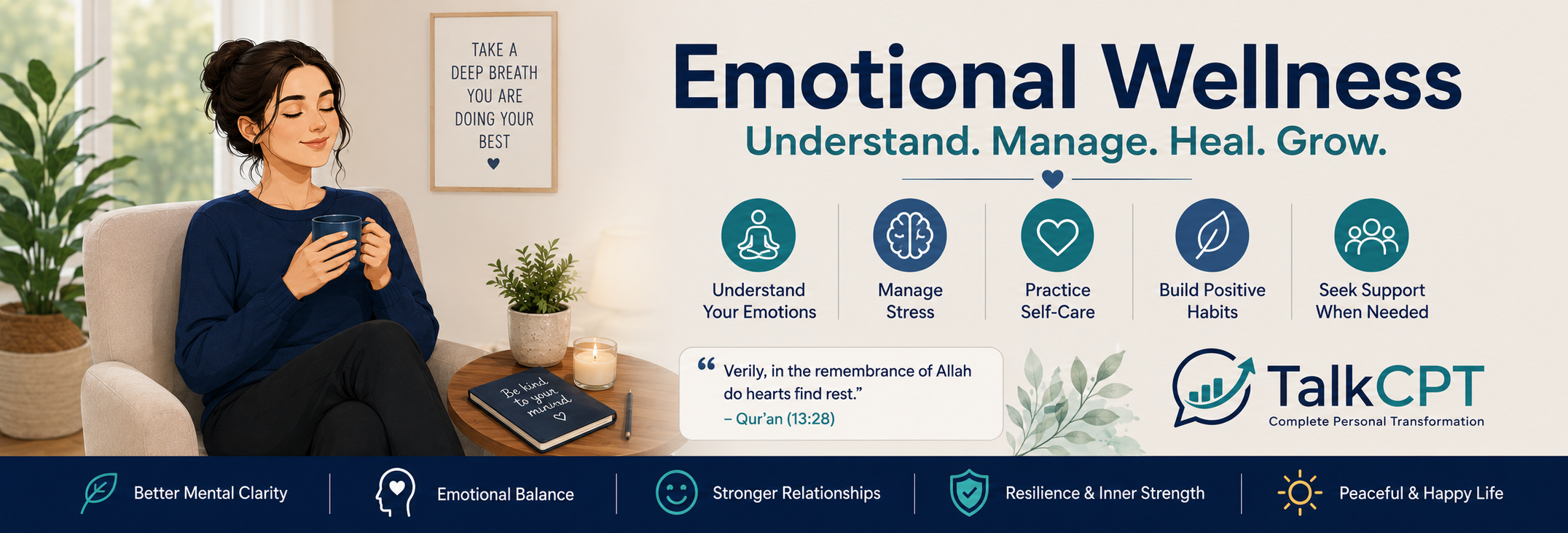
EMOTIONAL WELLNESS: A COMPLETE GUIDE TO INNER PEACE, RESILIENCE, AND SPIRITUAL BALANCE
Emotional wellness is the foundation of a healthy and meaningful life. It is not about feeling happy all the time. It is about understanding your emotions, handling stress with wisdom, and bouncing back from difficult situations with strength. A person who is emotionally well can face challenges without falling apart and can enjoy life with a sense of inner calm. This complete guide explains emotional wellness in depth, combining scientific research with the beautiful teachings of Islam.
WHAT IS EMOTIONAL WELLNESS
Emotional wellness means the ability to recognise, understand, and manage your emotions in a healthy way. The National Center for Emotional Wellness defines it as an awareness and acceptance of your feelings and the skill to manage effectively through challenges and change.
Emotionally well people are not free from problems. But they have tools to cope. They do not suppress their feelings. They acknowledge them, learn from them, and move forward with clarity.
Key aspects of emotional wellness include:
1. Self-awareness – knowing what you feel and why
2. Emotional regulation – managing intense emotions without harming yourself or others
3. Resilience – recovering from setbacks and adapting to change
4. Empathy – understanding the feelings of others
5. Healthy coping – using positive strategies to handle stress
6. Optimism – maintaining hope and perspective during difficulties
7. Balance – giving attention to different areas of life without burnout
WHY EMOTIONAL WELLNESS MATTERS FOR OVERALL HEALTH
Science confirms that emotional wellness directly impacts the body, mind, and relationships. The American Psychological Association reports that chronic stress and poor emotional management can lead to serious health issues, including heart disease, weakened immune function, anxiety, and depression.
Research shows that emotionally well individuals:
1. Have stronger immune systems and faster recovery from illness
2. Experience lower rates of depression and anxiety
3. Build healthier, more supportive relationships
4. Perform better at work and make clearer decisions
5. Live longer with greater life satisfaction
6. Handle grief and loss with more resilience
Islam also emphasises the importance of a sound heart and peaceful mind. The Quran says: “Those who have believed and whose hearts are assured by the remembrance of Allah. Unquestionably, by the remembrance of Allah hearts are assured” (Surah Ar-Ra’d, 13:28). Emotional wellness in Islam is deeply connected to spiritual wellness. When the heart is at peace with Allah, it becomes stronger against the storms of life.
UNDERSTANDING YOUR EMOTIONS
Emotions are not enemies. They are signals. Fear warns you of danger. Anger highlights injustice. Sadness marks loss. Joy fuels connection. When you learn to read these signals instead of ignoring or fearing them, you gain emotional intelligence.
Common emotions and their messages:
1. Anger – a sign that a boundary has been crossed or an injustice has occurred
2. Fear – a warning of possible harm or uncertainty ahead
3. Sadness – a signal of loss, disappointment, or unmet needs
4. Anxiety – a message about future uncertainty or perceived threat
5. Joy – confirmation of something good and life-giving
6. Guilt – a feeling that you may have violated your values
7. Envy – an indication of something you desire for yourself
Emotional wellness involves feeling these emotions without being controlled by them. Suppressing emotions repeatedly leads to physical tension, mental exhaustion, and sometimes outbursts. Acknowledging them calmly is the first step to managing them wisely.
The Prophet Muhammad (peace be upon him) experienced a full range of human emotions. He felt sadness at the loss of loved ones, concern for his followers, and joy in worship. He demonstrated that emotions are natural and that what matters is how we respond. He taught that when angry, one should sit down, remain silent, or perform ablution to cool down.
BUILDING SELF-AWARENESS
Self-awareness is the cornerstone of emotional wellness. You cannot manage what you do not understand. Developing self-awareness means regularly checking in with yourself and noticing your emotional patterns.
Practical ways to increase self-awareness:
1. Keep a simple emotions journal, writing down what you felt during the day
2. Identify triggers that cause strong emotional reactions
3. Notice physical signs like tight shoulders, fast heartbeat, or tension
4. Ask trusted people for honest feedback about your emotional patterns
5. Pause several times a day to ask yourself, “What am I feeling right now?”
6. Reflect on your childhood experiences and how they shaped your emotional responses
7. Practice mindfulness by observing your thoughts without judgment
Islamic teachings encourage self-reflection (muhasabah). The Quran says: “O you who have believed, fear Allah. And let every soul look to what it has put forth for tomorrow…” (Surah Al-Hashr, 59:18). Daily reflection on your inner state is a form of worship that builds emotional clarity.
COPING WITH STRESS AND ANXIETY
Stress is a normal part of life. But when it becomes chronic, it damages emotional wellness. Learning to manage stress effectively is a skill that can be developed through practice.
Healthy coping strategies backed by research:
1. Deep breathing exercises that activate the body’s relaxation response
2. Physical activity, which reduces cortisol and releases endorphins
3. Prioritising adequate sleep, as sleep deprivation increases emotional reactivity
4. Connecting with supportive people who listen without judgment
5. Limiting caffeine, sugar, and processed foods that spike anxiety
6. Organising your tasks and breaking large problems into small steps
7. Engaging in hobbies that bring joy and distract from worries
8. Practising gratitude, which shifts focus from problems to blessings
Islam provides powerful spiritual tools for stress management:
1. Salah (prayer) – regular prayer interrupts daily stress and provides moments of peace
2. Du’a (supplication) – pouring out your worries to Allah brings immense relief
3. Dhikr (remembrance of Allah) – repeating phrases like “SubhanAllah” and “Alhamdulillah” calms the heart
4. Tawakkul (trust in Allah) – knowing that the outcome is in Allah’s hands reduces anxiety
5. Reading the Quran – the words of Allah have a soothing effect on the soul
The Quran promises: “Indeed, with hardship [will be] ease” (Surah Ash-Sharh, 94:6). This verse provides hope that no difficulty lasts forever.
DEVELOPING EMOTIONAL RESILIENCE
Resilience is the ability to recover from setbacks, adapt to change, and keep going in the face of adversity. It is not about being tough or ignoring pain. It is about processing pain and moving forward without breaking.
How to build resilience:
1. Maintain perspective by remembering that most challenges are temporary
2. Focus on what you can control and release what you cannot
3. Draw strength from past experiences where you overcame difficulties
4. Cultivate a support system of family and friends
5. Practise self-compassion instead of harsh self-criticism
6. Find meaning in suffering by asking what you can learn
7. Keep a routine that includes self-care even during hard times
8. Hold onto hope and faith that relief will come
Islam presents resilience through the lives of the prophets. Prophet Ayyub (Job) lost his health, wealth, and children yet remained patient and grateful. Prophet Yusuf (Joseph) was betrayed, enslaved, and imprisoned but never lost hope in Allah’s plan. Their stories teach that resilience is built on faith, patience, and unwavering trust in Allah’s wisdom.
THE ROLE OF SELF-COMPASSION
Many people are harsh with themselves when they make mistakes or feel weak. This inner critic damages emotional wellness. Self-compassion means treating yourself with the same kindness you would offer a good friend.
Dr. Kristin Neff, a leading researcher on self-compassion, identifies three components:
1. Self-kindness – being gentle with yourself instead of critical
2. Common humanity – recognising that suffering is part of the shared human experience
3. Mindfulness – holding painful feelings in awareness without exaggerating them
Practical ways to practise self-compassion:
1. When you make a mistake, speak to yourself gently
2. Remind yourself that imperfection is human
3. Place your hand on your heart and offer yourself comforting words
4. Write a letter to yourself as if you were your own friend
5. Avoid comparing yourself to others, especially on social media
6. Celebrate your efforts, not just your achievements
Islam encourages mercy towards oneself. Allah’s attribute of mercy (Ar-Rahman) is central to faith. The Prophet (peace be upon him) said: “Allah is more merciful to His servants than a mother is to her child” (Sahih al-Bukhari). If Allah is so merciful, a believer should reflect some of that mercy inward.
THE CONNECTION BETWEEN PHYSICAL AND EMOTIONAL WELLNESS
The mind and body are deeply connected. Neglecting physical health damages emotional wellness. Research in psychoneuroimmunology shows that chronic stress, poor diet, lack of exercise, and inadequate sleep all worsen emotional health.
Physical habits that boost emotional wellness:
1. Regular exercise for at least 30 minutes most days
2. A balanced diet rich in whole foods, vegetables, and healthy fats
3. Adequate sleep of 7 to 9 hours per night
4. Hydration throughout the day
5. Reducing intake of alcohol, nicotine, and processed sugar
6. Spending time outdoors in natural light
7. Avoiding prolonged sitting and screen time without breaks
Islam promotes physical well-being as part of faith. The Prophet (peace be upon him) encouraged moderation in eating, saying: “No human ever filled a vessel worse than the stomach. It is sufficient for a person to eat a few mouthfuls to keep his back straight. But if he must fill it, then one third for food, one third for drink, and one third for air” (Sunan Ibn Majah). Physical discipline supports emotional clarity.
MANAGING DIFFICULT EMOTIONS WITHOUT HARM
Emotional wellness does not mean never feeling angry, jealous, or deeply sad. It means feeling these emotions without letting them control your actions or destroy your peace.
Techniques for managing intense emotions:
1. Pause and name the emotion – research shows that labelling emotions reduces their intensity
2. Remove yourself temporarily from a triggering situation
3. Practise deep breathing or grounding exercises
4. Write down what you feel without filtering or judging
5. Talk to someone you trust about what you are experiencing
6. Channel the energy into something productive, like exercise or art
7. Pray or make du’a, releasing the burden to Allah
Islam teaches that the strong person is not the one who wrestles others down, but the one who controls himself when angry (Sahih al-Bukhari). Self-control is highly praised and is a key sign of emotional maturity.
THE IMPORTANCE OF GRATITUDE
Gratitude is one of the most powerful tools for emotional wellness. Research by Dr. Robert Emmons shows that regularly practising gratitude increases happiness, improves sleep, strengthens relationships, and reduces depression.
Simple gratitude practices:
1. Write down three things you are grateful for every day
2. Express thanks to someone verbally or in writing each week
3. Spend a few moments reflecting on blessings before sleep
4. Shift negative thoughts by asking, “What is one good thing in this situation?”
5. Make a habit of saying “Alhamdulillah” throughout the day
The Quran repeatedly commands gratitude and links it to increased blessings: “If you are grateful, I will surely increase you [in favor]” (Surah Ibrahim, 14:7). Gratitude trains the mind to see abundance rather than lack, which directly improves emotional wellness.
DEALING WITH GRIEF AND LOSS
Grief is a natural response to loss. Whether it is the death of a loved one, the end of a marriage, loss of a job, or any major life change, grief can feel overwhelming. Emotional wellness involves allowing yourself to grieve while also finding a way forward.
Stages of grief commonly include denial, anger, bargaining, depression, and acceptance. Not everyone experiences all stages, and there is no fixed timeline.
Healthy ways to navigate grief:
1. Allow yourself to feel pain without rushing to fix it
2. Talk about your loss with trusted people
3. Maintain daily routines as anchors
4. Seek professional counselling if grief becomes immobilising
5. Turn to faith and du’a for comfort and perspective
6. Honour the memory of what was lost in meaningful ways
7. Be patient with yourself and trust that healing takes time
Islam acknowledges the pain of loss but offers immense comfort. The Prophet (peace be upon him) lost his wife Khadijah, his uncle Abu Talib, and several children. He wept, but he also said: “The eyes shed tears and the heart feels grief, but we do not say except what pleases our Lord” (Sahih al-Bukhari). Grieving is human, and faith provides a container for that pain.
A 30-DAY EMOTIONAL WELLNESS CHALLENGE
Small daily actions lead to lasting emotional strength. Here is a 30-day challenge to improve your emotional wellness.
Day 1: Write down three things you are grateful for.
Day 2: Identify one emotion you felt strongly today and name it.
Day 3: Practise 5 minutes of deep breathing in the morning.
Day 4: Go for a 20-minute walk without your phone.
Day 5: Write a kind letter to yourself about a struggle you are facing.
Day 6: Spend 10 minutes in dhikr or silent reflection.
Day 7: Call a friend or family member just to listen.
Day 8: Notice one negative thought and replace it with a balanced one.
Day 9: Do something creative, even for 15 minutes.
Day 10: Identify a boundary that needs strengthening and write it down.
Day 11: Perform two extra rak’ahs of prayer with presence.
Day 12: Reduce screen time for one hour before bed.
Day 13: Journal about a past difficulty and what you learned.
Day 14: Give a sincere compliment to someone.
Day 15: Say “no” to one thing that drains your energy.
Day 16: Listen to a calming recitation of the Quran.
Day 17: Take a break from social media for the whole day.
Day 18: Write down five strengths you have.
Day 19: Practise forgiving someone who hurt you, even if only in your heart.
Day 20: Try a new healthy recipe.
Day 21: Spend time in nature or near water.
Day 22: Read the story of a prophet and reflect on their patience.
Day 23: Make a du’a list of everything worrying you.
Day 24: Do a random act of kindness anonymously.
Day 25: Reflect on a happy memory in detail.
Day 26: Identify a trigger and write a plan to respond calmly.
Day 27: Share your feelings honestly with a trusted person.
Day 28: Release one expectation that is causing you stress.
Day 29: Write a letter to your future self with hope and encouragement.
Day 30: Celebrate one thing you have done well this month.
Consistency in these small steps rewires the brain for greater emotional wellness over time.
WHEN TO SEEK PROFESSIONAL HELP
Emotional wellness is something you can build yourself to a large extent. But sometimes professional help is necessary and wise. Seeking therapy or counselling is not a sign of failure. It is a sign of courage.
Consider seeking help if:
1. Sadness, anxiety, or anger persist for weeks and interfere with daily life
2. You struggle to get out of bed or complete basic tasks
3. You rely on substances to numb emotional pain
4. You feel hopeless or have thoughts of harming yourself
5. A traumatic event continues to haunt you
6. Your relationships are seriously affected by emotional issues
7. You feel disconnected from life for a long period
In Islam, seeking treatment is encouraged. The Prophet (peace be upon him) said: “Make use of medical treatment, for Allah has not made a disease without appointing a remedy for it” (Sunan Abi Dawud). Emotional and mental health is part of overall health, and seeking remedy is from the sunnah.
FREQUENTLY ASKED QUESTIONS ABOUT EMOTIONAL WELLNESS
Q: Is it normal to have bad days even when I practise emotional wellness?
A: Absolutely. Emotional wellness does not mean perfection. It means having the tools to handle bad days without losing hope. Accepting that ups and downs are normal is part of being emotionally well.
Q: How can I maintain emotional wellness during a major life crisis?
A: During a crisis, return to the basics: rest, eat, pray, connect with loved ones, and take one day at a time. Avoid making major decisions in the heat of the moment. Rely heavily on your faith and support system. Professional support can be especially helpful during such times.
Q: Does Islam see mental and emotional struggles as a sign of weak faith?
A: No. The prophets experienced deep emotional struggles. Yaqub (Jacob) cried until he lost his eyesight in grief for Yusuf. Aisha (may Allah be pleased with her) described the Prophet’s intense emotional states during revelation. Faith and emotional pain can coexist. What matters is turning to Allah through the pain, not pretending it does not exist.
Q: Can children and teenagers benefit from emotional wellness practices?
A: Yes. Teaching children to name their emotions, breathe deeply, and express feelings in healthy ways sets them up for a lifetime of emotional strength. The Prophet (peace be upon him) was extremely compassionate with children, listening to them and validating their feelings.
CONCLUSION: THE JOURNEY TOWARD INNER PEACE
Emotional wellness is a lifelong journey, not a final destination. It is built day by day through self-awareness, healthy habits, and a deep connection with Allah. By blending the best of modern psychology with the timeless wisdom of Islam, you can cultivate a heart that is at peace, a mind that is clear, and a spirit that is resilient.
Every small effort counts. Every tear understood, every deep breath taken, every moment of patience, and every du’a whispered is a step toward emotional wellness. May your heart find the peace it seeks, and may your emotional journey bring you closer to Allah and to the best version of yourself.
RESEARCH REFERENCES
1. American Psychological Association – Stress effects on the body and emotional health (apa.org)
2. Neff, K. D. – Self-Compassion research (self-compassion.org)
3. Emmons, R. A. – Gratitude and well-being research
4. National Center for Emotional Wellness – Definition of emotional wellness
5. Quran.com – Surah Ar-Ra’d 13:28, Surah Ash-Sharh 94:6, Surah Ibrahim 14:7, Surah Al-Hashr 59:18
6. Sunnah.com – Sahih al-Bukhari, Sahih Muslim, Sunan Ibn Majah, Sunan Abi Dawud, Sunan al-Tirmidhi
7. Prophet Muhammad (peace be upon him) – Hadith on anger management, mercy, and moderation
Emotional wellness is the foundation of a healthy and meaningful life. It is not about feeling happy all the time. It is about understanding your emotions, handling stress with wisdom, and bouncing back from difficult situations with strength. A person who is emotionally well can face challenges without falling apart and can enjoy life with a sense of inner calm. This complete guide explains emotional wellness in depth, combining scientific research with the beautiful teachings of Islam.
WHAT IS EMOTIONAL WELLNESS
Emotional wellness means the ability to recognise, understand, and manage your emotions in a healthy way. The National Center for Emotional Wellness defines it as an awareness and acceptance of your feelings and the skill to manage effectively through challenges and change.
Emotionally well people are not free from problems. But they have tools to cope. They do not suppress their feelings. They acknowledge them, learn from them, and move forward with clarity.
Key aspects of emotional wellness include:
1. Self-awareness – knowing what you feel and why
2. Emotional regulation – managing intense emotions without harming yourself or others
3. Resilience – recovering from setbacks and adapting to change
4. Empathy – understanding the feelings of others
5. Healthy coping – using positive strategies to handle stress
6. Optimism – maintaining hope and perspective during difficulties
7. Balance – giving attention to different areas of life without burnout
WHY EMOTIONAL WELLNESS MATTERS FOR OVERALL HEALTH
Science confirms that emotional wellness directly impacts the body, mind, and relationships. The American Psychological Association reports that chronic stress and poor emotional management can lead to serious health issues, including heart disease, weakened immune function, anxiety, and depression.
Research shows that emotionally well individuals:
1. Have stronger immune systems and faster recovery from illness
2. Experience lower rates of depression and anxiety
3. Build healthier, more supportive relationships
4. Perform better at work and make clearer decisions
5. Live longer with greater life satisfaction
6. Handle grief and loss with more resilience
Islam also emphasises the importance of a sound heart and peaceful mind. The Quran says: “Those who have believed and whose hearts are assured by the remembrance of Allah. Unquestionably, by the remembrance of Allah hearts are assured” (Surah Ar-Ra’d, 13:28). Emotional wellness in Islam is deeply connected to spiritual wellness. When the heart is at peace with Allah, it becomes stronger against the storms of life.
UNDERSTANDING YOUR EMOTIONS
Emotions are not enemies. They are signals. Fear warns you of danger. Anger highlights injustice. Sadness marks loss. Joy fuels connection. When you learn to read these signals instead of ignoring or fearing them, you gain emotional intelligence.
Common emotions and their messages:
1. Anger – a sign that a boundary has been crossed or an injustice has occurred
2. Fear – a warning of possible harm or uncertainty ahead
3. Sadness – a signal of loss, disappointment, or unmet needs
4. Anxiety – a message about future uncertainty or perceived threat
5. Joy – confirmation of something good and life-giving
6. Guilt – a feeling that you may have violated your values
7. Envy – an indication of something you desire for yourself
Emotional wellness involves feeling these emotions without being controlled by them. Suppressing emotions repeatedly leads to physical tension, mental exhaustion, and sometimes outbursts. Acknowledging them calmly is the first step to managing them wisely.
The Prophet Muhammad (peace be upon him) experienced a full range of human emotions. He felt sadness at the loss of loved ones, concern for his followers, and joy in worship. He demonstrated that emotions are natural and that what matters is how we respond. He taught that when angry, one should sit down, remain silent, or perform ablution to cool down.
BUILDING SELF-AWARENESS
Self-awareness is the cornerstone of emotional wellness. You cannot manage what you do not understand. Developing self-awareness means regularly checking in with yourself and noticing your emotional patterns.
Practical ways to increase self-awareness:
1. Keep a simple emotions journal, writing down what you felt during the day
2. Identify triggers that cause strong emotional reactions
3. Notice physical signs like tight shoulders, fast heartbeat, or tension
4. Ask trusted people for honest feedback about your emotional patterns
5. Pause several times a day to ask yourself, “What am I feeling right now?”
6. Reflect on your childhood experiences and how they shaped your emotional responses
7. Practice mindfulness by observing your thoughts without judgment
Islamic teachings encourage self-reflection (muhasabah). The Quran says: “O you who have believed, fear Allah. And let every soul look to what it has put forth for tomorrow…” (Surah Al-Hashr, 59:18). Daily reflection on your inner state is a form of worship that builds emotional clarity.
COPING WITH STRESS AND ANXIETY
Stress is a normal part of life. But when it becomes chronic, it damages emotional wellness. Learning to manage stress effectively is a skill that can be developed through practice.
Healthy coping strategies backed by research:
1. Deep breathing exercises that activate the body’s relaxation response
2. Physical activity, which reduces cortisol and releases endorphins
3. Prioritising adequate sleep, as sleep deprivation increases emotional reactivity
4. Connecting with supportive people who listen without judgment
5. Limiting caffeine, sugar, and processed foods that spike anxiety
6. Organising your tasks and breaking large problems into small steps
7. Engaging in hobbies that bring joy and distract from worries
8. Practising gratitude, which shifts focus from problems to blessings
Islam provides powerful spiritual tools for stress management:
1. Salah (prayer) – regular prayer interrupts daily stress and provides moments of peace
2. Du’a (supplication) – pouring out your worries to Allah brings immense relief
3. Dhikr (remembrance of Allah) – repeating phrases like “SubhanAllah” and “Alhamdulillah” calms the heart
4. Tawakkul (trust in Allah) – knowing that the outcome is in Allah’s hands reduces anxiety
5. Reading the Quran – the words of Allah have a soothing effect on the soul
The Quran promises: “Indeed, with hardship [will be] ease” (Surah Ash-Sharh, 94:6). This verse provides hope that no difficulty lasts forever.
DEVELOPING EMOTIONAL RESILIENCE
Resilience is the ability to recover from setbacks, adapt to change, and keep going in the face of adversity. It is not about being tough or ignoring pain. It is about processing pain and moving forward without breaking.
How to build resilience:
1. Maintain perspective by remembering that most challenges are temporary
2. Focus on what you can control and release what you cannot
3. Draw strength from past experiences where you overcame difficulties
4. Cultivate a support system of family and friends
5. Practise self-compassion instead of harsh self-criticism
6. Find meaning in suffering by asking what you can learn
7. Keep a routine that includes self-care even during hard times
8. Hold onto hope and faith that relief will come
Islam presents resilience through the lives of the prophets. Prophet Ayyub (Job) lost his health, wealth, and children yet remained patient and grateful. Prophet Yusuf (Joseph) was betrayed, enslaved, and imprisoned but never lost hope in Allah’s plan. Their stories teach that resilience is built on faith, patience, and unwavering trust in Allah’s wisdom.
THE ROLE OF SELF-COMPASSION
Many people are harsh with themselves when they make mistakes or feel weak. This inner critic damages emotional wellness. Self-compassion means treating yourself with the same kindness you would offer a good friend.
Dr. Kristin Neff, a leading researcher on self-compassion, identifies three components:
1. Self-kindness – being gentle with yourself instead of critical
2. Common humanity – recognising that suffering is part of the shared human experience
3. Mindfulness – holding painful feelings in awareness without exaggerating them
Practical ways to practise self-compassion:
1. When you make a mistake, speak to yourself gently
2. Remind yourself that imperfection is human
3. Place your hand on your heart and offer yourself comforting words
4. Write a letter to yourself as if you were your own friend
5. Avoid comparing yourself to others, especially on social media
6. Celebrate your efforts, not just your achievements
Islam encourages mercy towards oneself. Allah’s attribute of mercy (Ar-Rahman) is central to faith. The Prophet (peace be upon him) said: “Allah is more merciful to His servants than a mother is to her child” (Sahih al-Bukhari). If Allah is so merciful, a believer should reflect some of that mercy inward.
THE CONNECTION BETWEEN PHYSICAL AND EMOTIONAL WELLNESS
The mind and body are deeply connected. Neglecting physical health damages emotional wellness. Research in psychoneuroimmunology shows that chronic stress, poor diet, lack of exercise, and inadequate sleep all worsen emotional health.
Physical habits that boost emotional wellness:
1. Regular exercise for at least 30 minutes most days
2. A balanced diet rich in whole foods, vegetables, and healthy fats
3. Adequate sleep of 7 to 9 hours per night
4. Hydration throughout the day
5. Reducing intake of alcohol, nicotine, and processed sugar
6. Spending time outdoors in natural light
7. Avoiding prolonged sitting and screen time without breaks
Islam promotes physical well-being as part of faith. The Prophet (peace be upon him) encouraged moderation in eating, saying: “No human ever filled a vessel worse than the stomach. It is sufficient for a person to eat a few mouthfuls to keep his back straight. But if he must fill it, then one third for food, one third for drink, and one third for air” (Sunan Ibn Majah). Physical discipline supports emotional clarity.
MANAGING DIFFICULT EMOTIONS WITHOUT HARM
Emotional wellness does not mean never feeling angry, jealous, or deeply sad. It means feeling these emotions without letting them control your actions or destroy your peace.
Techniques for managing intense emotions:
1. Pause and name the emotion – research shows that labelling emotions reduces their intensity
2. Remove yourself temporarily from a triggering situation
3. Practise deep breathing or grounding exercises
4. Write down what you feel without filtering or judging
5. Talk to someone you trust about what you are experiencing
6. Channel the energy into something productive, like exercise or art
7. Pray or make du’a, releasing the burden to Allah
Islam teaches that the strong person is not the one who wrestles others down, but the one who controls himself when angry (Sahih al-Bukhari). Self-control is highly praised and is a key sign of emotional maturity.
THE IMPORTANCE OF GRATITUDE
Gratitude is one of the most powerful tools for emotional wellness. Research by Dr. Robert Emmons shows that regularly practising gratitude increases happiness, improves sleep, strengthens relationships, and reduces depression.
Simple gratitude practices:
1. Write down three things you are grateful for every day
2. Express thanks to someone verbally or in writing each week
3. Spend a few moments reflecting on blessings before sleep
4. Shift negative thoughts by asking, “What is one good thing in this situation?”
5. Make a habit of saying “Alhamdulillah” throughout the day
The Quran repeatedly commands gratitude and links it to increased blessings: “If you are grateful, I will surely increase you [in favor]” (Surah Ibrahim, 14:7). Gratitude trains the mind to see abundance rather than lack, which directly improves emotional wellness.
DEALING WITH GRIEF AND LOSS
Grief is a natural response to loss. Whether it is the death of a loved one, the end of a marriage, loss of a job, or any major life change, grief can feel overwhelming. Emotional wellness involves allowing yourself to grieve while also finding a way forward.
Stages of grief commonly include denial, anger, bargaining, depression, and acceptance. Not everyone experiences all stages, and there is no fixed timeline.
Healthy ways to navigate grief:
1. Allow yourself to feel pain without rushing to fix it
2. Talk about your loss with trusted people
3. Maintain daily routines as anchors
4. Seek professional counselling if grief becomes immobilising
5. Turn to faith and du’a for comfort and perspective
6. Honour the memory of what was lost in meaningful ways
7. Be patient with yourself and trust that healing takes time
Islam acknowledges the pain of loss but offers immense comfort. The Prophet (peace be upon him) lost his wife Khadijah, his uncle Abu Talib, and several children. He wept, but he also said: “The eyes shed tears and the heart feels grief, but we do not say except what pleases our Lord” (Sahih al-Bukhari). Grieving is human, and faith provides a container for that pain.
A 30-DAY EMOTIONAL WELLNESS CHALLENGE
Small daily actions lead to lasting emotional strength. Here is a 30-day challenge to improve your emotional wellness.
Day 1: Write down three things you are grateful for.
Day 2: Identify one emotion you felt strongly today and name it.
Day 3: Practise 5 minutes of deep breathing in the morning.
Day 4: Go for a 20-minute walk without your phone.
Day 5: Write a kind letter to yourself about a struggle you are facing.
Day 6: Spend 10 minutes in dhikr or silent reflection.
Day 7: Call a friend or family member just to listen.
Day 8: Notice one negative thought and replace it with a balanced one.
Day 9: Do something creative, even for 15 minutes.
Day 10: Identify a boundary that needs strengthening and write it down.
Day 11: Perform two extra rak’ahs of prayer with presence.
Day 12: Reduce screen time for one hour before bed.
Day 13: Journal about a past difficulty and what you learned.
Day 14: Give a sincere compliment to someone.
Day 15: Say “no” to one thing that drains your energy.
Day 16: Listen to a calming recitation of the Quran.
Day 17: Take a break from social media for the whole day.
Day 18: Write down five strengths you have.
Day 19: Practise forgiving someone who hurt you, even if only in your heart.
Day 20: Try a new healthy recipe.
Day 21: Spend time in nature or near water.
Day 22: Read the story of a prophet and reflect on their patience.
Day 23: Make a du’a list of everything worrying you.
Day 24: Do a random act of kindness anonymously.
Day 25: Reflect on a happy memory in detail.
Day 26: Identify a trigger and write a plan to respond calmly.
Day 27: Share your feelings honestly with a trusted person.
Day 28: Release one expectation that is causing you stress.
Day 29: Write a letter to your future self with hope and encouragement.
Day 30: Celebrate one thing you have done well this month.
Consistency in these small steps rewires the brain for greater emotional wellness over time.
WHEN TO SEEK PROFESSIONAL HELP
Emotional wellness is something you can build yourself to a large extent. But sometimes professional help is necessary and wise. Seeking therapy or counselling is not a sign of failure. It is a sign of courage.
Consider seeking help if:
1. Sadness, anxiety, or anger persist for weeks and interfere with daily life
2. You struggle to get out of bed or complete basic tasks
3. You rely on substances to numb emotional pain
4. You feel hopeless or have thoughts of harming yourself
5. A traumatic event continues to haunt you
6. Your relationships are seriously affected by emotional issues
7. You feel disconnected from life for a long period
In Islam, seeking treatment is encouraged. The Prophet (peace be upon him) said: “Make use of medical treatment, for Allah has not made a disease without appointing a remedy for it” (Sunan Abi Dawud). Emotional and mental health is part of overall health, and seeking remedy is from the sunnah.
FREQUENTLY ASKED QUESTIONS ABOUT EMOTIONAL WELLNESS
Q: Is it normal to have bad days even when I practise emotional wellness?
A: Absolutely. Emotional wellness does not mean perfection. It means having the tools to handle bad days without losing hope. Accepting that ups and downs are normal is part of being emotionally well.
Q: How can I maintain emotional wellness during a major life crisis?
A: During a crisis, return to the basics: rest, eat, pray, connect with loved ones, and take one day at a time. Avoid making major decisions in the heat of the moment. Rely heavily on your faith and support system. Professional support can be especially helpful during such times.
Q: Does Islam see mental and emotional struggles as a sign of weak faith?
A: No. The prophets experienced deep emotional struggles. Yaqub (Jacob) cried until he lost his eyesight in grief for Yusuf. Aisha (may Allah be pleased with her) described the Prophet’s intense emotional states during revelation. Faith and emotional pain can coexist. What matters is turning to Allah through the pain, not pretending it does not exist.
Q: Can children and teenagers benefit from emotional wellness practices?
A: Yes. Teaching children to name their emotions, breathe deeply, and express feelings in healthy ways sets them up for a lifetime of emotional strength. The Prophet (peace be upon him) was extremely compassionate with children, listening to them and validating their feelings.
CONCLUSION: THE JOURNEY TOWARD INNER PEACE
Emotional wellness is a lifelong journey, not a final destination. It is built day by day through self-awareness, healthy habits, and a deep connection with Allah. By blending the best of modern psychology with the timeless wisdom of Islam, you can cultivate a heart that is at peace, a mind that is clear, and a spirit that is resilient.
Every small effort counts. Every tear understood, every deep breath taken, every moment of patience, and every du’a whispered is a step toward emotional wellness. May your heart find the peace it seeks, and may your emotional journey bring you closer to Allah and to the best version of yourself.
RESEARCH REFERENCES
1. American Psychological Association – Stress effects on the body and emotional health (apa.org)
2. Neff, K. D. – Self-Compassion research (self-compassion.org)
3. Emmons, R. A. – Gratitude and well-being research
4. National Center for Emotional Wellness – Definition of emotional wellness
5. Quran.com – Surah Ar-Ra’d 13:28, Surah Ash-Sharh 94:6, Surah Ibrahim 14:7, Surah Al-Hashr 59:18
6. Sunnah.com – Sahih al-Bukhari, Sahih Muslim, Sunan Ibn Majah, Sunan Abi Dawud, Sunan al-Tirmidhi
7. Prophet Muhammad (peace be upon him) – Hadith on anger management, mercy, and moderation
Remember
It’s okay to feel stressed sometimes. But taking small, consistent steps can help you feel more in control and live a happier, healthier life.
Share this article
Talk to Our Emotional Wellness Experts
 Online
Dr. Ayesha Khalid
Clinical Psychologist
MS Clinical Psychology
4.9
(230)
Lahore
PKR 5,000
/ session
 Available
Muhammad Bilal
Career Coach
MBA Human Resource Management
4.9
(210)
Karachi
PKR 4,000
/ session
 Online
Sarah Khan
AI & Prompt Engineer
BS Software Engineering
4.8
(180)
Islamabad
PKR 3,500
/ session
Smoke Expert
Prompt Coach
Certified AI trainer
0.0
(0)
Lahore
PKR 2,500
/ session